
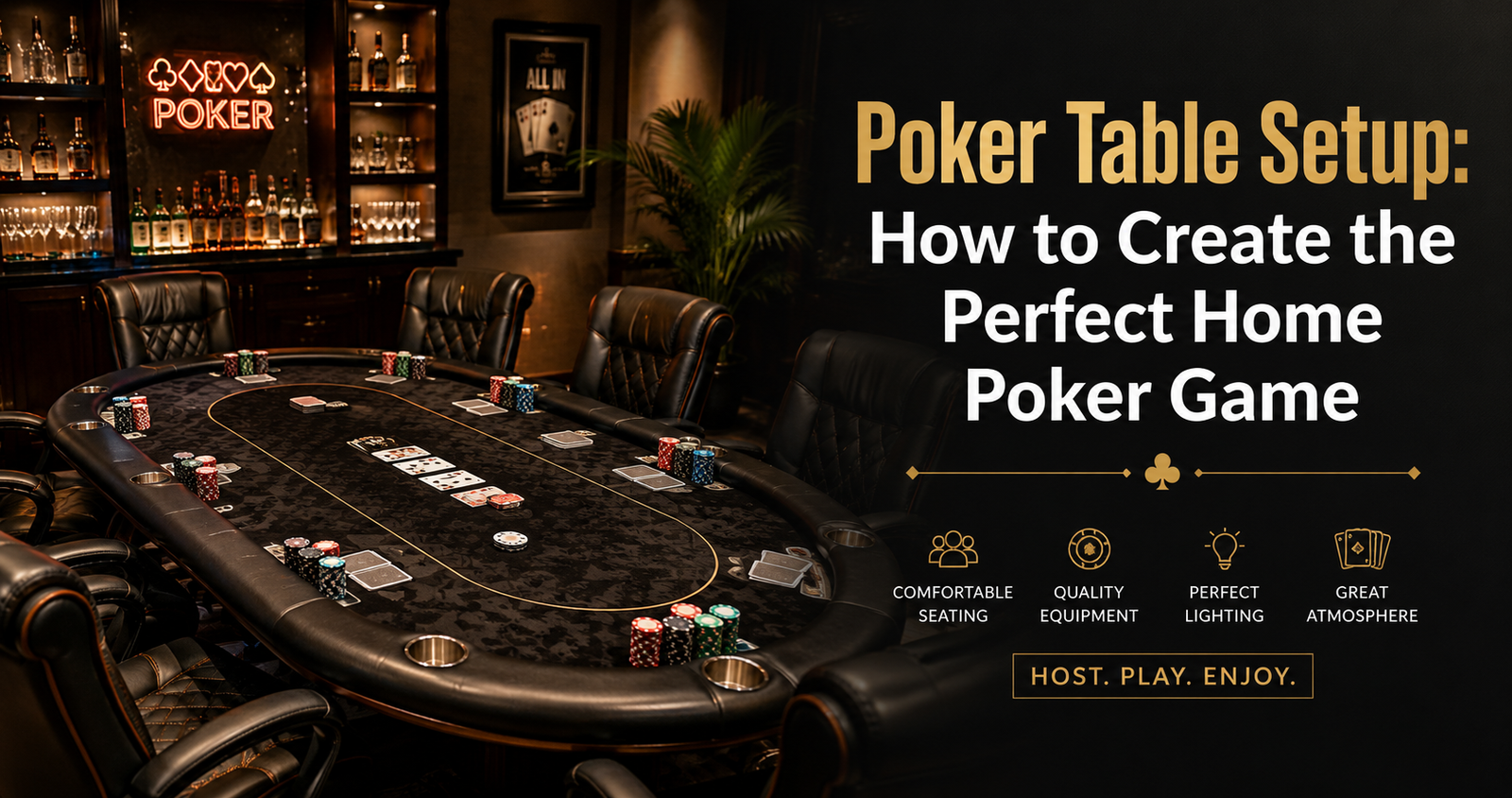
Poker Table Setup: How to Create the Perfect Home Poker Game
A well-planned poker table setup can make a home game more comfortable, organized, and enjoyable for everyone at the table. Whether you are hosting a casual evening with friends or putting together a dedicated poker room, the details matter. The right table, seating arrangement, playing cards, chip organization, lighting, and house rules can all contribute to a smoother experience.
Many players focus mainly on the cards and chips, but the physical environment around the game can have an equally important practical effect. A crowded table can make dealing awkward, poor lighting can make cards difficult to see, and an unclear chip structure can create confusion during betting.
This guide explains how to build a practical poker table setup from the ground up. You will learn how to choose the right table dimensions, arrange seats, organize chips and cards, improve lighting, establish house rules, and avoid common mistakes. The goal is not to create an unnecessarily elaborate room, but to build a playing environment that is comfortable, clear, and suitable for the type of poker you plan to play.
The best poker table is not necessarily the most expensive one—it is the one that keeps the game organized and the players comfortable.
What Makes a Good Poker Table Setup?
A strong poker table setup combines several elements that work together. The table itself needs enough space for players to sit comfortably while leaving room in the center for community cards, chips, and the dealer position. Seating should allow players to reach the table without constantly bumping into one another, while the lighting should provide clear visibility without creating glare.
The type of poker being played also matters. A small home game using Texas Hold’em may require a different arrangement from a larger tournament-style event. Similarly, a dedicated poker table offers a different experience from using a dining table with a removable poker topper.
The most important factors usually include table size, playing surface, seating, lighting, cards, chips, dealer equipment, and the rules governing the game. Together, these details determine whether the game feels relaxed and easy to manage or unnecessarily disorganized.
Quick Poker Table Setup Checklist
| Setup Element | What to Consider | Why It Matters |
|---|---|---|
| Table size | Number of players and available room | Prevents overcrowding |
| Table shape | Oval, round, or rectangular | Affects seating and player access |
| Playing surface | Felt, speed cloth, or suitable tabletop | Supports smooth card and chip movement |
| Seating | Comfortable chairs with enough space | Helps players remain comfortable |
| Poker chips | Clear denominations and sufficient quantity | Makes betting easier to understand |
| Playing cards | Durable, standard-sized cards | Supports consistent dealing |
| Dealer button | Clearly visible button | Helps identify dealer position |
| Lighting | Even, bright, low-glare illumination | Improves card visibility |
| Chip storage | Trays, racks, or organized containers | Keeps the table tidy |
| House rules | Agreed rules before play begins | Reduces disputes |
| Accessories | Card protectors, cut card, timer if needed | Improves organization |
| Space around table | Enough room for movement | Makes the overall environment more practical |
Choosing the Right Table Size and Shape
The ideal table size depends primarily on how many people will play and how much room is available. A table designed for a large group may be uncomfortable in a small room, while a compact table can feel crowded when too many players sit around it.
Poker tables are commonly designed in oval, racetrack, or round configurations, although rectangular tables can also be used for home games. Oval tables are popular because they provide a relatively efficient arrangement for multiple players while maintaining a clear central playing area.
For casual games, a standard dining table can often be adapted with a poker topper or suitable playing mat. This can be a practical choice for people who do not want a permanent poker table. Dedicated tables, on the other hand, may offer padded armrests, built-in drink holders, and a surface specifically designed for card games.
Before buying or building a table, measure the room carefully. Consider not only the dimensions of the tabletop but also the space required for chairs and movement. A table that technically fits inside a room may still be impractical if players cannot comfortably pull out their chairs or walk behind the seating area.
The surface should also be large enough for the cards and chips without forcing players to reach excessively far. Comfort is particularly important during longer sessions, where poor positioning can quickly become noticeable.
Seating and Player Positioning
Seating is one of the most overlooked aspects of a poker table setup. Even a high-quality table can feel uncomfortable if players are sitting too close together or using chairs that are unsuitable for extended periods.
Each player should have enough personal space to handle cards and chips without interfering with the person next to them. Chairs should also be positioned so that players can easily stand up when necessary without disturbing the game.
For home games, ordinary dining chairs can work well if they provide adequate support. Dedicated poker chairs are another option, but they are not essential for a good game. The key consideration is comfort and appropriate spacing rather than appearance.
The dealer position should also be easy to identify. In casino-style games, a dealer button is typically used to indicate the nominal dealer position and establish the order of action. The button moves around the table after each hand, ensuring that the blinds and other positions rotate according to the rules of the game.
For games with a dedicated dealer, the physical dealer position may remain fixed while the dealer button continues to determine player positions. The exact arrangement depends on the poker variant and the rules being used.
Organizing Cards, Chips, and Dealer Equipment
Good organization helps keep the game moving smoothly. Before play begins, all essential equipment should be placed where players can access it without repeatedly interrupting the action.
Playing cards should be clean, durable, and easy to handle. Many home games use two decks, with one deck in play and another available for the next hand. However, the second deck is not strictly necessary for casual play.
Poker chips should be clearly separated by denomination. Players should be able to identify the value of each chip quickly, and everyone should understand the denominations before the first hand begins.
A dealer button is useful for tracking position, while a cut card can be used when appropriate to help protect the bottom of the deck during dealing. A chip tray or storage box can also keep unused chips organized.
For tournament-style games, additional equipment may include a visible timer, blind-level schedule, and designated tournament rules. Cash games generally require less equipment but still benefit from clearly defined chip values and procedures.
Lighting and Room Arrangement
Lighting has a direct effect on the usability of a poker table. Players need to see their cards and chips clearly, but harsh or poorly positioned lighting can create reflections and shadows.
A central overhead light can provide broad illumination, while multiple fixtures may offer more even coverage in larger rooms. The goal is to illuminate the playing surface without shining directly into players’ eyes.
Natural light can also be useful during daytime games, but direct sunlight may create glare on cards or screens. Window coverings can help control changing light conditions.
The surrounding room should be arranged with enough space for players to move around. Drinks and snacks should ideally be placed where they are accessible without creating a significant risk of spills near cards or chips. Using stable drink holders or a nearby side table can help keep the main playing surface clear.
Setting Up Poker Chips and Betting Structure
The chip arrangement should be decided before the game starts. Players need to know what each denomination represents and how chips will be exchanged or removed from play when necessary.
In a cash game, chip values normally correspond directly to the agreed monetary stakes. Players should understand the value of every chip in circulation before buying into the game.
Tournament poker works differently. Tournament chips generally represent units used for scoring and betting rather than having a direct cash value during play. The tournament structure should specify starting stacks, blind levels, and any relevant rules.
A useful setup is to place chip denominations in clearly separated stacks. Players can then quickly identify their available betting options without repeatedly asking about chip values.
It is also important to establish procedures for making bets and handling chips. Players should know whether verbal declarations are binding, how minimum raises work under the selected rules, and what happens when a player pushes forward an unclear amount.
Creating Clear House Rules
A professional poker table setup is not only about physical equipment. Clear rules are equally important.
Before starting, players should agree on the poker variant, blinds or betting limits, buy-in arrangements, rebuys if applicable, and procedures for disputes. It is also helpful to clarify whether players can leave the table temporarily and how missed blinds or returning players are handled.
For casual games, the rules can be relatively simple. However, even friendly games benefit from having expectations established in advance.
Common areas that should be clarified include:
- Which poker variant is being played
- Starting chip stacks
- Blind or betting structure
- Minimum and maximum buy-ins
- Whether rebuys are allowed
- How side pots are handled
- How dealer errors are resolved
- What happens if a card is exposed accidentally
- Whether players may discuss hands during play
- How disputes are settled
- When the game officially ends
A written rules sheet is particularly useful for larger home tournaments. It reduces arguments and gives everyone the same reference point.
How We Evaluate Online Casinos
This article focuses on poker table setup rather than recommending or ranking online casinos. For that reason, casino evaluation criteria such as licensing, game selection, payment methods, mobile compatibility, customer support, and responsible gambling tools are not used to assess the physical poker environment described here.
When comparing online poker or casino services separately, readers should independently examine factors such as licensing, security, game availability, payment procedures, customer support, and responsible gambling measures. Those considerations are relevant to online gambling services but do not determine whether a physical poker table is properly arranged.
For a home poker game, the more relevant evaluation criteria are practical: table dimensions, player capacity, seating comfort, lighting, equipment quality, organization, and clearly agreed rules.
Common Mistakes Players Make
One of the most common mistakes is choosing a table that is too small for the intended number of players. While adding more seats may appear convenient, overcrowding makes it harder to handle cards and chips comfortably.
Another mistake is ignoring the height of the table and chairs. Even a high-quality playing surface can become uncomfortable when chairs are too low or the table is positioned at an awkward height.
Poor lighting is another frequent issue. Players may initially overlook it, but glare and shadows can become frustrating during a long session. Lighting should be tested from different seating positions before the game begins.
Some hosts also underestimate the importance of chip organization. Mixing denominations or failing to explain their values can create unnecessary confusion. A few minutes spent organizing chips before the game can save much more time later.
Another avoidable problem is starting without agreeing on rules. Disagreements over betting procedures, buy-ins, or exposed cards can interrupt an otherwise enjoyable game.
Finally, hosts sometimes place food and drinks directly beside the playing area. This increases the chance of accidental spills and can make the table unnecessarily cluttered. A separate surface for refreshments is usually a better arrangement.
Warning Signs of Poor Poker Table Setup
A poor setup is often easy to recognize once you know what to look for. The first warning sign is overcrowding. If players repeatedly bump elbows or struggle to reach their chips, the table is probably being used beyond its practical capacity.
Unstable tables are another concern. A table that moves whenever someone rests an arm on it can disrupt cards and chips and make the game frustrating.
Damaged or heavily worn cards may also cause problems. Marked or bent cards can create questions about fairness, even when no wrongdoing is intended. Replacing worn decks is a simple way to maintain confidence in the game.
Unclear chip denominations are another warning sign. If players cannot quickly identify the value of chips, betting becomes unnecessarily complicated.
Poor lighting, inadequate seating, and insufficient space around the table can similarly reduce the quality of the experience. These problems may seem minor individually, but together they can make a game feel poorly organized.
A final warning sign is the absence of agreed rules. When players do not know how disputes or unusual situations will be handled, even a friendly game can become tense.
How to Build a Poker Table Setup on a Budget
Creating a good playing environment does not require buying an expensive dedicated poker table. A sturdy dining table can provide an effective foundation for casual games, particularly when paired with a removable poker mat or topper.
Start with the essentials: a stable table, comfortable seating, quality playing cards, and clearly marked chips. Once these are in place, consider improvements such as better lighting, drink holders, chip trays, and a dedicated storage box.
If space is limited, a foldable table can be practical because it can be stored after the game. A removable tabletop surface can also transform an ordinary table without permanently changing the room.
Budget-conscious hosts should prioritize function over decoration. A stable surface and comfortable chairs will generally contribute more to the quality of a game than expensive visual accessories.
For anyone building a permanent poker room, planning the room around the table is more important than purchasing accessories first. Measure the available space, determine the maximum number of players, and then choose furniture that fits comfortably.
How to Make a Home Poker Game Feel More Professional
Professional presentation comes mainly from consistency and organization rather than expensive equipment.
Begin by preparing everything before players arrive. Set out the cards, organize the chips, position the dealer button, and ensure the lighting is ready. Players should not have to wait while the host searches for equipment.
A consistent seating arrangement also helps. Players should know where they can sit, while the dealer position and button should be clearly identified.
Use clear terminology and announce important actions when necessary. In larger games, a simple structure for dealing and betting can prevent confusion.
The playing surface should remain clean and uncluttered. Remove unnecessary objects from the table and keep refreshments in a separate area whenever possible.
Most importantly, establish the rules before the first hand. A game that runs smoothly because everyone understands the procedures will usually feel more professional than one with expensive furniture but constant interruptions.
Conclusion
A well-designed poker table setup is ultimately about creating an environment where the game can run smoothly. The table should provide enough space, the seating should be comfortable, the lighting should make cards easy to see, and the chips and cards should be organized before play begins.
The physical arrangement is only one part of the equation. Clear house rules, consistent dealing procedures, and agreed betting structures are equally important for avoiding confusion. A simple setup that is carefully planned can often provide a better experience than an expensive table surrounded by poor lighting, cramped seating, or unclear rules.
When planning your own table, start with the essentials: determine how many people will play, measure the available room, choose a stable surface, arrange comfortable seating, and organize the equipment. From there, improve the experience with practical additions that genuinely make the game easier to manage.
The most important takeaway is straightforward: a good poker table setup should support the game rather than distract from it. When players have enough space, understand the rules, and can easily see and handle their cards and chips, the entire experience becomes more comfortable, organized, and enjoyable.
FAQS
What is the ideal size for a poker table?
The ideal size depends on the number of players and the available room. A table should provide enough personal space for each player while leaving room for community cards, chips, and dealing.
How many players can sit at a poker table?
Capacity varies by table design and size. A dedicated table may be designed for a specific number of players, while a standard table can often accommodate fewer players comfortably than its physical dimensions might suggest.
Do I need a dedicated poker table for home games?
No. A sturdy dining table with a suitable poker mat or removable topper can work well for casual games. A dedicated poker table mainly offers convenience, specialized features, and a more permanent playing environment.
What equipment is essential for a poker game?
At minimum, you generally need suitable playing cards, poker chips, a table, comfortable seating, and a clear understanding of the rules. A dealer button is also useful for identifying player positions.
How should poker chips be organized?
Chips should be separated by denomination and clearly explained before the game begins. Keeping denominations in organized stacks makes betting and chip exchanges easier to manage.
Read More
After Article Read To visit Least News
Barber Shop Near Me: Find Top-Rated Local Barbers for Expert Haircuts & Grooming
Massage Near Me: Find the Best Local Massage Services for Relaxation, Pain Relief & Wellness
Spa Near Me: Discover Top-Rated Local Spas for Relaxation, Beauty Treatments & Wellness
Yoga Studio Near Me: Find the Best Yoga Classes, Wellness Programs & Expert Instructors Near You
Fitness Center Near Me: Find the Best Gym, Trainers, Equipment & Fitness Programs Nearby
Gym Near Me: Find the Best Local Fitness Center for Workouts, Training & Health Goals
Basketball Court Near Me: Find Top-Rated Local Courts, Indoor Gyms & Pickup Games
Tennis Court Near Me: Find Top Local Courts, Prices, Booking Options & Playing Tips
Golf Course Near Me: Discover the Best Local Golf Courses, Clubs & Playing Experiences
Bowling Alley Near Me: Find the Best Local Bowling Centers for Fun, Events & Family Entertainment
Vegetarian Restaurant Near Me: Discover Fresh, Delicious & Top-Rated Plant-Based Dining Options
Food Truck Near Me: Find the Best Local Food Trucks, Menus, Locations & Hidden Food Gems
Chicken Restaurant Near Me: How to Find a Great Local Chicken Meal
Sandwich Shop Near Me”: Biography, Local Search Intent, and How Google Ranks Sandwich Shops in 2026
Tea Shop Near Me: How Local Tea Shops Can Attract Nearby Customers
Juice Bar Near Me: How to Find a Fresh, Reliable Local Option
Smoothie Shop Near Me: Your Complete Guide to Finding the Best Local Smoothie Bars in 2026
Donut Shop Near Me: Your Guide to America’s Best Doughnut Destinations in 2026
Taco Restaurant Near Me: How to Find a Great Local Taco Spot
BBQ Restaurants Near Me: How to Find a Great Local Smokehouse
Italian Restaurant Near Me: How to Find a Great Local Italian Meal
Burger Restaurant Near Me: How to Find a Great Local Burger Spot
Steakhouse Near Me: How to Find a Great Steakhouse for Your Next Meal
Sushi Restaurant Near Me: How to Choose a Great Local Sushi Spot
Chinese Restaurant Near Me: How to Find a Better Local Restaurant
Mexican Restaurant Near Me: A Better Guide to Finding Great Mexican Food
Ice Cream Near Me: How to Find a Great Local Scoop
Bakery Near Me: How to Find a Great Local Bakery in the USA
Brunch Near Me: How to Find a Great Local Brunch Without Guesswork
Breakfast Near Me: How to Find a Great Breakfast Spot Nearby
Fast Food Near Me: How to Find the Best Nearby Restaurant
Pizza Near Me: How to Find a Great Local Pizza Place in the USA
Gas Station Near Me: Find Reliable Fuel, Services & Best Stops Fast
Tire Shop Near Me: Find Trusted Local Tire Services & Expert Care
Swimming Pool Near Me: Find Clean, Safe & Best Local Pools
ATM Near Me: Find Safe, Convenient Cash Access Quickly
Pet Store Near Me: Find Trusted Local Pet Supplies & Services
Chase Bank Near Me: Find Branches, ATMs, Hours & Services
U.S. Bank Near Me: Find Nearby Branches, ATMs and Services
Laundromat Near Me: Find a Clean, Reliable Laundry Service
Crackstube: What It Is, What CracksTube.com Does, and Why the Name Causes Confusion
Dentist Near Me: Find a Trusted Local Dentist for Expert Dental Care & Healthy Smiles
Hair Salon Near Me: Find Expert Stylists for Haircuts, Color, Styling & Beauty Services
Coffee Shop Near Me: Find Quality Coffee, Comfort & Great Local Cafés
TheSindi com: What the Website Is, What It Covers, and How to Use It







One Comment