
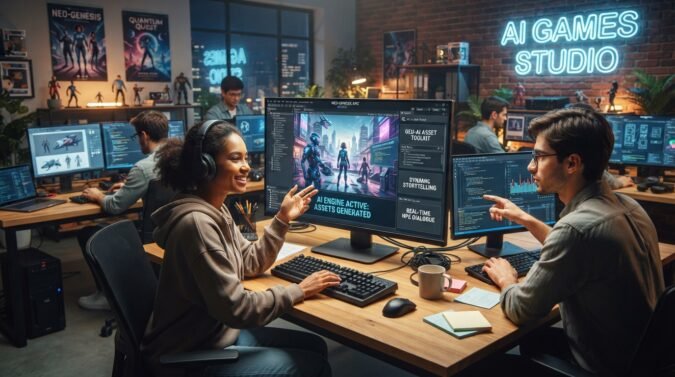

AI games are video games that use artificial intelligence in some part of the playing experience. The term can mean several things. It may describe a game with smart computer-controlled characters, a game that creates stories or worlds with generative AI, or a game where AI is part of the main gameplay loop.
The important point is that AI games are not all the same. Some use AI mainly to help developers build a game. Others use AI directly while you play. Newer AI-native games can generate dialogue, quests, characters, or parts of a game world as the player interacts with them. Research published in 2026 also separates AI-native games from ordinary games that simply use AI as an extra feature.
What Are AI Games?
AI games are games that use artificial intelligence to create, control, adapt, or change parts of the gaming experience.
Traditional games often use fixed rules. For example, an enemy may follow a set path, attack when the player enters a certain area, or use a limited group of responses.
AI can make these systems more flexible.
Depending on the game, AI may be used for:
- Non-player character behavior
- Enemy decision-making
- Dynamic dialogue
- Story generation
- Quest generation
- Personalized game experiences
- Adaptive difficulty
- Game-world creation
- Automated testing
- Player behavior analysis
- Voice or text interaction
Generative AI adds another layer. Instead of only following pre-written rules, a system may create text, images, dialogue, or other content during play.
That is why the phrase AI games now covers a wide range of experiences.
How Do AI Games Work?
The technology behind an AI game depends on what the developer wants the AI to do.
Rule-Based Game AI
This is the traditional form of game AI.
Developers create rules that tell characters how to respond to certain situations. A guard might patrol an area, notice the player, and chase them.
This type of AI has been used in games for many years. It does not necessarily use modern generative AI.
Machine Learning
Machine learning allows a system to find patterns from data rather than relying only on manually written rules.
In gaming, machine learning can be used for areas such as player analysis, testing, recommendation systems, or certain types of character behavior.
Generative AI
Generative AI can create new content based on an input.
In games, this may include:
- Character conversations
- Story events
- Images
- Game items
- Missions
- World elements
- Voice interactions
Google Cloud has described this direction as “living games,” where AI can help games respond to player actions and create changing experiences.
AI Agents
AI agents can perform a sequence of actions instead of simply generating one response.
In gaming, this could allow characters or systems to make decisions, respond to changing conditions, and interact with the game world in more complex ways.
This area is still developing, but current game-development research and industry work are moving toward more autonomous AI-driven systems.
The Main Types of AI Games
The easiest way to understand AI games is to divide them into a few groups.
| Type | How AI is used | What the player may notice |
|---|---|---|
| AI-enhanced games | AI controls or improves parts of gameplay | Smarter enemies, NPCs, or adaptive systems |
| Generative AI games | AI creates content during play | New dialogue, stories, items, or environments |
| AI-native games | AI is central to the main gameplay loop | The game would be very different without AI |
| AI-assisted games | AI mainly helps developers make the game | Players may not notice the AI directly |
This distinction matters because a game made with AI is not automatically an AI game.
For example, a developer may use an AI coding assistant to build a traditional game. The finished game may contain no AI-driven gameplay at all.
By contrast, an AI-native game depends on AI as an important part of what the player actually does. A 2026 research survey describes this difference by asking whether removing the AI would fundamentally change the game’s central gameplay loop.
What Makes AI Games Different From Traditional Games?
The biggest difference is how much of the experience can change while you play.
A traditional game usually has content designed and tested before release. The developers decide much of the story, dialogue, level layout, characters, and rules in advance.
An AI-driven game may generate or change some of those elements while the game is running.
For example, instead of choosing one of several pre-written conversations, a player might type a question and receive a new response from an AI character.
Instead of following the same story path every time, an AI system might create different events based on what the player has done.
This can make games feel more personal and unpredictable. It can also create new problems, because generated content may not always behave exactly as the developer intended.
What Are the Benefits of AI Games?
AI can offer several useful possibilities for players and developers.
More Dynamic Characters
AI can help characters respond to players in less predictable ways.
This can make conversations and interactions feel more flexible than a fixed list of dialogue options.
Personalized Experiences
AI systems can potentially adjust parts of a game according to the player’s actions, skill level, or choices.
For example, a game could change the difficulty or provide different challenges based on how someone plays.
More Content
Generative systems can produce large amounts of content. This may help developers experiment with more stories, environments, or gameplay ideas.
However, more content is not automatically better. Good game design still requires rules, balance, testing, and a clear reason for the content to exist.
Faster Development
AI tools can also help developers with coding, testing, planning, and other development tasks.
Unity’s 2026 gaming report says developers are using AI for several development activities, with coding assistance among the most commonly reported uses in its survey.
Unity also introduced an AI tool suite designed specifically for game-development workflows, including an in-editor assistant and other development tools.
What Are the Problems With AI Games?
AI games also have important limits.
Inconsistent Results
Generative AI does not always produce the same quality of response.
A character may give an excellent answer in one situation and a strange or unhelpful answer in another.
Story and Gameplay Problems
A game needs clear rules and goals.
If AI generates too much without strong controls, the story can become confusing or the gameplay can lose direction.
A 2026 academic survey notes that AI generation alone does not guarantee that a game will be playable. Good AI-native design still needs goals, rules, feedback, pacing, and player control.
Privacy Questions
Some AI games may use online AI services to process player input.
If a game allows you to type personal information into an AI character or system, it is worth checking the game’s privacy policy before sharing anything sensitive.
Cost and Performance
AI systems can require cloud computing or other resources.
Some games may limit how much AI interaction a player gets, charge for additional usage, or require an internet connection.
Creative and Legal Concerns
The use of AI in game development also raises questions about creative ownership, training data, generated assets, voice use, and the role of human creators.
These issues vary by technology, company, country, and the specific content involved, so players and developers should not assume that every AI-generated asset has the same legal status.
Are AI Games Worth Trying?
For many players, they can be worth trying if you enjoy experimentation and unusual gameplay.
AI games may be especially interesting if you like:
- Interactive stories
- Role-playing games
- Open-ended conversations
- Experimental games
- Procedurally changing worlds
- Character-driven experiences
- Games that respond to natural language
They may be less appealing if you prefer carefully scripted stories, fixed dialogue, predictable rules, and highly polished traditional gameplay.
There is no single answer because AI games are a broad category.
A game with AI-generated dialogue can feel completely different from an AI-powered world-building game.
How to Choose an AI Game
Before playing an AI game, look beyond the word “AI.”
Ask what the AI actually does.
1. Check Whether AI Is Part of Gameplay
A game may advertise AI even though the technology is used mainly during development.
If you want an AI-driven playing experience, look for information about AI characters, generated content, adaptive gameplay, or real-time generation.
2. Check the Game’s Main Mechanic
Ask yourself what you will actually do.
Is the game a story adventure? A role-playing game? A world-building tool? A strategy game? A chat-based experience?
The AI should support the type of gameplay you enjoy.
3. Look at Privacy Information
If the game uses text or voice input, check how that information is handled.
Avoid entering sensitive personal information unless you understand where it goes and how it is used.
4. Check Internet Requirements
Some AI experiences depend on online servers.
A game may therefore require an internet connection even if other parts of the game normally could work offline.
5. Look for Real Gameplay Information
Do not judge a game only by its AI label.
Screenshots, gameplay videos, developer information, and independent reviews can tell you more about whether the actual experience is enjoyable.
AI Games vs. Games Made With AI
These terms are easy to confuse.
AI games use AI as part of the player experience.
Games made with AI use AI as a development tool.
For example, a developer might use an AI assistant to help write code. The finished game could still be a completely traditional game.
This difference is becoming more important as game studios use AI for development work. Unity’s 2026 report shows that studios are using AI across areas such as coding, narrative design, automated testing, NPC behavior, and other development tasks.
So the presence of AI somewhere in the development process does not automatically make the finished game an AI-native game.
What Is the Future of AI Games?
AI is likely to give developers more ways to create responsive and personalized games.
One possible direction is the growth of games where characters remember more about previous interactions, environments change based on player actions, and stories respond to natural-language choices.
Another direction is AI-assisted development. Developers can use AI to reduce repetitive work and spend more time on game design, testing, and creative decisions.
But AI will not automatically solve the hardest problems in game development.
A good game still needs:
- Clear goals
- Strong game mechanics
- Good pacing
- Fair rules
- Useful feedback
- Interesting choices
- Testing
- Player control
The most successful AI games are therefore likely to use AI for a clear gameplay purpose rather than adding AI simply because it is a new technology.
Frequently Asked Questions
What are AI games?
AI games are games that use artificial intelligence in gameplay, character behavior, content generation, or other parts of the player experience. The exact role of AI can vary greatly from one game to another.
Are all games with AI characters AI games?
Not necessarily. Traditional games have used computer-controlled characters for many years. A modern AI game may use more advanced systems, including machine learning or generative AI, but the label alone does not tell you how the technology works.
What is an AI-native game?
An AI-native game is one where AI is a central part of the gameplay loop. If the AI were removed, the core experience would change substantially or stop working as intended.
Can AI create a game while you play?
Yes, some experimental systems can generate parts of a game experience at runtime. Depending on the system, AI may create dialogue, stories, environments, characters, or other content.
Are AI games free?
Some are free, while others are paid. AI games may also have subscriptions, usage limits, or other costs because some AI features require ongoing computing resources.
Are AI games better than traditional games?
Not automatically. AI can make games more flexible and unpredictable, but traditional games can offer stronger control, polished storytelling, and carefully balanced gameplay. The better choice depends on what the player enjoys.
Conclusion
AI games are changing what a video game can do. Instead of relying only on content created before release, some games can use AI to create dialogue, adapt gameplay, control characters, or generate parts of the experience while you play.
The most important thing is to understand what the term means in a particular game. Some games use AI directly in gameplay, while others only use AI as a development tool.
For players, the best approach is simple: look at the actual gameplay, understand what the AI does, check privacy and internet requirements, and decide whether the experience matches the type of game you enjoy.
AI can make games more dynamic, but good game design still matters most.