
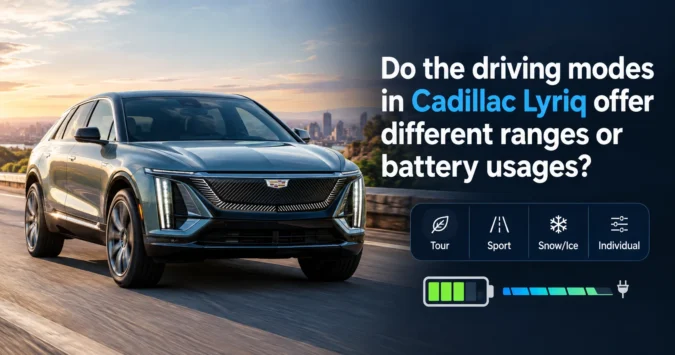

The Cadillac LYRIQ gives drivers several ways to change how the electric SUV feels on the road. The available driving modes include Tour, Sport, Snow/Ice, and My Mode. Each mode is made for a different driving situation or personal preference.
This leads to a common question: Do Cadillac LYRIQ driving modes change range or battery usage?
The short answer is that the driving modes can affect how the vehicle uses energy, but they do not create different battery capacities or fixed range levels. The physical battery remains the same for a given vehicle configuration. What changes is how the LYRIQ responds to the accelerator, steering, braking, and road conditions.
Cadillac describes Tour as the main mode for everyday driving. Sport gives a more direct torque response and a stronger road feel. Snow/Ice changes accelerator behavior to help reduce wheel spin, while My Mode lets the driver adjust several driving characteristics.
The difference becomes more important when you look at real-world EV efficiency. Driving speed, acceleration, outside temperature, road surface, hills, wind, traffic, tires, vehicle weight, and climate control can all change how much electricity the LYRIQ uses.
A driving mode changes the way the LYRIQ behaves. It does not change the size of the battery.
Cadillac LYRIQ Driving Modes Explained
The LYRIQ’s driver mode system is designed to change the driving experience rather than provide separate battery settings.
Cadillac currently lists four main driving modes for the standard LYRIQ: Tour, Sport, Snow/Ice, and My Mode. The exact equipment and available features can vary by model and trim.
| LYRIQ driving mode | Main purpose | Possible effect on energy use |
|---|---|---|
| Tour | Everyday driving and smooth response | Usually suitable for normal, steady driving |
| Sport | Faster response and stronger driving feel | Can use more energy when driven aggressively |
| Snow/Ice | Better control on slippery roads | Depends heavily on weather and road conditions |
| My Mode | Personalized driving settings | Depends on the settings and driving style |
This table is important because it shows why there is no simple answer such as “Sport reduces range by X miles.”
Cadillac does not publish a fixed range reduction for Sport mode, nor does it list a separate EPA range for each standard driving mode. The published range figures are tied to the vehicle’s powertrain and configuration.
For the 2026 LYRIQ, Cadillac lists up to 326 miles of EPA-estimated range for single-motor RWD models and up to 319 miles for available dual-motor AWD models with standard 11.5-kW charging. A dual-motor AWD version with the available 19.2-kW charging system is listed at 303 miles.
These numbers should not be read as “Tour range,” “Sport range,” or “Snow/Ice range.”
Does Sport Mode Use More Battery?
Sport mode can use more battery energy in real driving, but the mode itself does not automatically remove a fixed number of miles from the range.
Cadillac says Sport mode is designed for a stronger road connection, more immediate torque response, and improved steering at higher speeds.
That setup can make it easier for a driver to accelerate harder. Strong acceleration requires more electrical power from the battery.
For example, a driver may use Sport mode and drive smoothly at a steady speed. Another driver may select Sport mode and repeatedly accelerate hard. The second driving pattern can use much more energy.
This is why it is not accurate to say that Sport mode always cuts the LYRIQ’s range by a specific percentage.
Several things work together:
- Electric motor power demand
- Accelerator input
- Vehicle speed
- Road grade
- Traffic
- Wind
- Vehicle load
- Tire condition
- Outside temperature
- Cabin heating or cooling
- Stop-and-go driving
- Use of regenerative braking
Sport mode changes the response of the vehicle, but the driver’s behavior remains one of the major factors in energy consumption.
Does Tour Mode Give Better LYRIQ Range?
Tour is the main everyday driving mode for the LYRIQ. Cadillac describes it as a mode with tuning and calibration designed for a smooth ride.
For many drivers, Tour can be a practical choice when the goal is calm and predictable driving.
However, it would be too strong to say that Tour always produces the longest possible range.
A driver using Tour at a very high highway speed may use more energy than another driver using Sport at a lower, steady speed. The mode is only one part of the total energy picture.
A useful way to think about it is:
Driving mode + driving behavior + road conditions = real-world energy use.
Tour can support a smooth driving style, but it does not turn the LYRIQ into a different battery-powered vehicle.
Does Sport Mode Change the Battery Capacity?
No.
Selecting Sport mode does not physically increase or decrease the battery capacity of the Cadillac LYRIQ.
For example, Cadillac’s 2026 LYRIQ specifications list a 102-kWh battery capacity for the standard vehicle configuration in independent specifications from Edmunds.
Changing from Tour to Sport does not turn that battery into a smaller or larger battery.
What can change is the rate at which electrical energy is used.
Think about it like using a phone. The battery has a fixed capacity, but some activities use more power than others. A similar basic idea applies to an electric vehicle.
Sport driving can demand more power when the driver makes frequent hard accelerations or maintains higher speeds. That can cause the battery percentage to fall faster.
What Does Snow/Ice Mode Do?
Snow/Ice mode has a different purpose from Sport mode.
Cadillac says Snow/Ice mode is intended to help prevent wheel spin on snow or other slippery roads. Cadillac’s general Driver Mode Control information explains that Snow/Ice changes the pedal map by slowing acceleration and torque response to help control wheel slip.
This means Snow/Ice is mainly about traction and control, not creating an EV range boost.
If the LYRIQ is being driven on a slippery road, the road itself can have a large effect on energy use. Snow, ice, water, cold temperatures, poor traction, and slower traffic can all change the amount of energy needed for a trip.
So it would be misleading to call Snow/Ice a dedicated “battery-saving mode.”
Its main job is to help the driver manage power more smoothly when traction is limited.
Can Snow/Ice Mode Reduce Energy Use?
It can change how the accelerator responds, but there is no official Cadillac figure showing that Snow/Ice mode provides a specific battery saving or extra number of miles.
In some situations, smoother acceleration may help avoid unnecessary wheel spin and sudden power demand. But that does not mean the mode guarantees better efficiency.
Weather is a much bigger part of the picture.
Cold conditions can affect EV performance and range. Snow-covered roads can increase rolling resistance. Headwinds can require more power. Cabin heating can also use electrical energy.
That means a driver could see lower range in winter even while using Snow/Ice mode correctly.
The correct way to understand this mode is:
Snow/Ice helps manage traction. It is not a separate long-range battery setting.
What Is My Mode on the Cadillac LYRIQ?
My Mode is designed for drivers who want more control over the driving experience.
Cadillac says My Mode can allow the driver to personalize characteristics such as:
- Accelerator responsiveness
- Steering feel
- Braking responsiveness
- Electric Vehicle Sound Enhancement
The exact options can depend on the vehicle’s equipment.
Because My Mode is customizable, its effect on battery use cannot be given as one fixed number.
One driver may select settings that feel calm and smooth. Another may choose a more responsive setup.
Even then, the selected settings do not change the physical battery capacity.
The important point is that My Mode is a personalization feature, not a separate battery mode.
Does Regenerative Braking Affect LYRIQ Range?
Yes, regenerative braking is an important part of the LYRIQ’s energy system.
Cadillac describes regenerative braking as a way to capture braking energy and support additional range. The LYRIQ also offers Regen on Demand and One-Pedal Driving features.
When an EV slows down through regenerative braking, the electric motor can work as part of the energy recovery process. Some of the vehicle’s movement energy can be converted back into electrical energy.
This does not mean every bit of energy used to accelerate comes back during braking. There are losses in the process.
Still, regenerative braking can help make better use of energy during normal driving, especially when the vehicle must slow down.
Cadillac says One-Pedal Driving can be set to different levels, including Off, On/Normal, and High.
This is separate from simply choosing Tour or Sport.
One-Pedal Driving and Battery Usage
One-Pedal Driving lets the driver control slowing and stopping mainly with the accelerator pedal under normal conditions.
Cadillac says the system can provide a moderate level of braking when the accelerator is released, while the High setting increases the amount of deceleration.
This can make city driving easier for some drivers.
However, One-Pedal Driving should not be treated as a guaranteed range booster. Its benefit depends on the type of driving being done.
It is also important to follow Cadillac’s safety guidance. Cadillac says One-Pedal Driving is not recommended on slippery wet, snowy, or icy roads.
Drivers should use the brake pedal when needed.
Regen on Demand and LYRIQ Energy Recovery
The LYRIQ also has a steering-wheel-mounted Regen on Demand paddle.
Cadillac explains that the paddle lets the driver adjust regenerative braking power based on how much pressure is applied.
This gives the driver another way to control deceleration without treating the driving mode itself as a range setting.
Regenerative braking is especially useful in situations where the vehicle needs to slow down repeatedly. City streets, traffic, hills, and stop-and-go conditions can create more opportunities for energy recovery than a long stretch of constant-speed highway driving.
Still, regeneration does not create free unlimited energy. The LYRIQ first uses energy to move, and only some of that energy can be recovered during deceleration.
What Really Determines Cadillac LYRIQ Range?
Driving mode is only one factor in EV range.
The LYRIQ’s actual driving range can change from one trip to another because many parts of the driving environment are different.
Driving Speed
Speed can have a major effect on EV energy use.
At higher highway speeds, aerodynamic resistance becomes more important. The vehicle can need more power to maintain speed.
This means a LYRIQ traveling quickly on a highway may use electricity at a different rate from one traveling at moderate city speeds.
Acceleration
Hard acceleration demands more power from the electric drive system.
Smooth acceleration can make it easier to control energy use. Frequent rapid acceleration followed by heavy braking can also create an inefficient driving pattern because some of the energy used for movement is later lost as heat or recovered only partly through regeneration.
Temperature
Temperature matters for electric vehicles.
Very cold or very hot conditions can affect battery performance and vehicle energy use. Climate control can also require electrical power.
For example, heating a cabin in cold weather can increase electricity demand. Cooling the cabin in hot weather also uses energy.
Road Conditions
Road surface and weather can change range.
Rain, snow, ice, standing water, loose surfaces, and rough roads can increase resistance or require more careful driving.
This is another reason a fixed “LYRIQ range in Sport mode” number would not accurately describe every trip.
Hills and Terrain
Climbing a hill requires additional energy because the vehicle is gaining elevation.
A downhill section can allow the vehicle to recover some energy through regenerative braking, but the total energy balance depends on the entire route.
A trip through a hilly area can therefore show different energy consumption from a similar-distance trip on flat roads.
Wind
A strong headwind can increase the power needed to maintain speed.
A tailwind can have the opposite effect.
Because wind conditions change from day to day, two trips over the same road can have different energy results.
Tires and Tire Pressure
Tires affect rolling resistance.
The type of tire, tire condition, road surface, and correct tire pressure can all influence efficiency.
Keeping tires at the pressure specified for the vehicle is an important part of normal vehicle care.
Passenger and Cargo Weight
More weight means the electric vehicle must move more mass.
A fully loaded LYRIQ may therefore use energy differently from a lightly loaded vehicle.
Cargo, passengers, roof equipment, and towing can all affect energy consumption.
2026 Cadillac LYRIQ Range Figures
For the 2026 model year, Cadillac lists different range figures based on the powertrain.
| LYRIQ configuration | Published range |
|---|---|
| Single-motor RWD | Up to 326 miles EPA-estimated |
| Dual-motor AWD with standard 11.5-kW charging | Up to 319 miles EPA-estimated |
| Dual-motor AWD with available 19.2-kW charging | Up to 303 miles EPA-estimated |
| LYRIQ-V | 285 miles EPA-estimated |
Cadillac’s 2026 specifications list the standard LYRIQ at up to 326 miles with rear-wheel drive and up to 319 miles for the dual-motor AWD version with standard 11.5-kW charging. The available 19.2-kW charging configuration is listed at 303 miles.
The 2026 LYRIQ-V is a different performance model. Cadillac lists its range at 285 miles, with the vehicle using a 102-kWh battery system.
These numbers show an important point: powertrain and vehicle configuration can change the official range. Standard driving modes are not listed as separate battery capacities.
Independent 2026 LYRIQ specifications from Edmunds also list a 102-kWh battery and 326-mile EPA electric range for the rear-wheel-drive model.
Does AWD Use More Battery Than RWD?
The LYRIQ is available with rear-wheel drive and dual-motor all-wheel drive.
The published 2026 range figures are different between the two configurations. Cadillac lists up to 326 miles for RWD and up to 319 miles for the dual-motor AWD configuration with standard 11.5-kW charging.
This difference is not caused by switching between Tour and Sport.
It comes from the vehicle’s powertrain configuration.
AWD can provide benefits in traction and performance, but adding another motor and changing the powertrain can also affect energy consumption and official range.
That is why shoppers should compare the actual LYRIQ configuration rather than assuming every LYRIQ has exactly the same range.
Does the LYRIQ Show Battery Usage in Real Time?
The vehicle provides energy and charging information to help drivers understand how the EV is being used.
Cadillac also provides EV route planning through the myCadillac app and in-vehicle Google built-in maps. Cadillac says route planning can include charging station information and an estimated battery level at arrival.
This can be more useful for a long trip than relying only on the original EPA range number.
The estimated remaining range can change during a journey as the vehicle learns more about current conditions and recent driving.
For example, a driver may begin with a high estimated range. After several miles of high-speed driving, the estimated remaining distance may change more quickly than expected.
That does not necessarily mean the battery suddenly developed a problem. It can simply reflect a change in predicted energy consumption.
Why Estimated Range Can Move Up or Down
An EV range estimate is not a promise that the vehicle will travel exactly that distance.
The estimate is based on available battery energy and expected energy consumption.
If recent driving is efficient, the estimated range can behave differently than it would after a period of high energy use.
Conditions can change too.
A driver might begin a trip in cool weather and then enter warmer conditions. Traffic may become heavier. A hill may appear on the route. The driver may increase highway speed.
Each change can affect predicted range.
This is why drivers should watch both battery percentage and estimated remaining range, rather than treating one number as guaranteed.
Does Climate Control Affect LYRIQ Battery Usage?
Yes.
Heating and cooling require electrical energy.
This matters because an EV does not have a gasoline engine producing large amounts of waste heat in the same way as a traditional gasoline vehicle. Cabin heating and cooling are part of the vehicle’s overall electrical energy demand.
On a hot day, strong air conditioning can increase energy use.
On a cold day, cabin heating can also increase energy demand.
This means two LYRIQ drivers using the same driving mode can see different range results simply because their climate settings and weather conditions are different.
Does Highway Driving Reduce LYRIQ Range?
Highway driving can produce higher energy use at high speeds.
This is not because the LYRIQ suddenly switches to a different battery mode. It is mainly related to the physical energy required to move the vehicle through the air and maintain speed.
A steady moderate speed may use less energy than repeated high-speed acceleration.
For long trips, drivers should consider:
- Current battery percentage
- Remaining estimated range
- Highway speed
- Weather
- Wind
- Traffic
- Elevation
- Charging locations
- Cabin temperature
- Passenger and cargo load
These factors can matter more than the name of the selected driving mode.
Common Mistakes About LYRIQ Driving Modes
Mistake 1: Thinking Sport Has a Smaller Battery
It does not.
Sport changes driving behavior and vehicle response. It does not physically reduce battery capacity.
Mistake 2: Assuming Tour Guarantees Maximum Range
Tour is designed for everyday driving, but it cannot guarantee a specific range.
A high-speed trip in Tour can still use a lot of energy.
Mistake 3: Calling Snow/Ice a Range Mode
Snow/Ice is mainly a traction mode.
It adjusts accelerator behavior to help control wheel spin on slippery roads.
Mistake 4: Believing My Mode Changes Battery Size
My Mode changes selected driving characteristics.
It does not replace the physical battery or change its capacity.
Mistake 5: Treating EPA Range as a Trip Guarantee
EPA-estimated range is a standardized figure used for comparison. Real-world driving can produce different results.
Mistake 6: Ignoring Temperature
Cold and hot conditions can affect EV energy use.
A range estimate from mild weather should not be treated as a guaranteed result in extreme weather.
Mistake 7: Looking Only at the Driving Mode
A driver can have more impact on energy use through speed and acceleration than through simply selecting a different mode.
Warning Signs of Misleading LYRIQ Range Claims
Readers should be careful with articles or posts that make exact claims such as:
- “Sport mode always loses 20 miles.”
- “Tour adds exactly 30 miles.”
- “Snow/Ice mode saves a fixed percentage.”
- “My Mode increases battery capacity.”
- “One-Pedal Driving guarantees extra range.”
- “The LYRIQ always gets its EPA range.”
These statements are too broad without specific test conditions.
A trustworthy range discussion should explain the vehicle configuration and driving conditions.
It should also separate official EPA estimates from real-world tests and personal experiences.
Cadillac itself notes that actual range can vary based on factors such as temperature, terrain, battery condition, loading, and vehicle use.
How to Get More Consistent LYRIQ Range
Drivers who want predictable EV range can focus on basic habits.
Drive Smoothly
Use steady accelerator inputs where road conditions allow.
Avoid unnecessary hard acceleration and sudden changes in speed.
Keep Highway Speeds Reasonable
Higher speeds can increase energy demand.
A calm, steady driving pattern can help reduce sudden changes in consumption.
Watch the Weather
Plan for different energy use during very hot or cold conditions.
Use Regenerative Braking Correctly
Regenerative braking can recover some energy during deceleration. Use it as intended and follow Cadillac’s guidance for road conditions.
Check Tire Pressure
Proper tire pressure supports normal vehicle efficiency and handling.
Plan Long Trips
Use the LYRIQ’s available route-planning and charging tools to identify charging stops and monitor estimated battery level at arrival.
Avoid Treating the Range Number as Fixed
Use the range estimate as a planning tool rather than a guarantee.
Battery Charging and Daily Use
Driving modes are also separate from battery charging settings.
Cadillac recommends charging the battery to 80% for daily use to help support battery health and leave room for regenerative braking. For longer trips, Cadillac says drivers can charge above 80% when additional range is needed.
This is important because battery charge level and driving mode are two different things.
Selecting Sport does not mean the battery should be charged differently.
Selecting Tour does not create a special battery-saving charging level.
The best charging approach depends on daily driving needs, trip length, and the manufacturer’s guidance.
What About the LYRIQ-V?
The LYRIQ-V needs to be considered separately from the standard LYRIQ.
Cadillac lists the 2026 LYRIQ-V with dual-motor AWD, 615 horsepower in Velocity Max, and a Cadillac-estimated 285 miles of EPA-estimated range.
The LYRIQ-V also has additional performance-focused features and V-Mode.
Cadillac says V-Mode allows performance settings to be customized, while Velocity Max can provide additional power and acceleration.
Because the LYRIQ-V is designed for stronger performance, its energy use should not be compared directly with the standard RWD LYRIQ simply by looking at driving-mode names.
A Better Way to Think About LYRIQ Efficiency
Instead of asking, “Which mode gives me the most miles?” it is more useful to ask:
How much energy does my LYRIQ use during the type of driving I actually do?
That question includes the full driving situation.
A short city trip may involve many stops and starts. A highway trip may involve sustained higher speed. A winter trip may require cabin heating. A summer trip may require strong air conditioning.
The same LYRIQ can therefore show very different energy consumption on different days.
The selected mode matters, but it is only one part of the system.
Expert Takeaway: Mode vs. Energy Consumption
The key distinction is between vehicle settings and energy demand.
Tour changes the driving character toward everyday comfort. Sport makes the response more immediate. Snow/Ice adjusts accelerator behavior for slippery surfaces. My Mode allows selected characteristics to be personalized.
None of these standard modes changes the physical battery size.
Energy use depends on what the vehicle is being asked to do.
If the driver accelerates hard, travels fast, carries a heavy load, drives into strong wind, climbs hills, or uses a lot of cabin heating or cooling, electricity use can increase.
Regenerative braking can recover some energy during slowing, but it cannot completely replace the energy used to move the vehicle.
This is why there is no single “Sport mode battery usage” number that applies to every LYRIQ driver.
Does Sport mode reduce Cadillac LYRIQ range?
Sport mode can contribute to higher energy use when it leads to stronger acceleration or faster driving. Cadillac does not publish a fixed number of miles that Sport mode removes from the LYRIQ’s range.
Is Tour mode the most efficient LYRIQ setting?
Tour is the main everyday mode and is designed for a smooth driving experience. However, real efficiency also depends on speed, acceleration, weather, traffic, terrain, tires, climate control, and vehicle load.
Does Snow/Ice mode save battery?
Snow/Ice is designed mainly to help reduce wheel spin on slippery roads. It should not be treated as a dedicated battery-saving or long-range mode.
Does My Mode change LYRIQ battery capacity?
No. My Mode changes selected driving characteristics. It does not change the physical capacity of the LYRIQ battery.
Does regenerative braking improve LYRIQ range?
Regenerative braking can capture some braking energy and return it to the vehicle’s electrical system. Cadillac describes regenerative braking as a feature that can help conserve energy and add range.
What affects LYRIQ range the most?
There is no single factor for every trip. Speed, acceleration, temperature, terrain, wind, road conditions, tires, climate control, vehicle load, traffic, and powertrain configuration can all affect energy consumption.
How much range does a 2026 LYRIQ have?
Cadillac lists up to 326 miles of EPA-estimated range for the 2026 single-motor RWD LYRIQ and up to 319 miles for the dual-motor AWD configuration with standard 11.5-kW charging. The available 19.2-kW AWD configuration is listed at 303 miles.
Does changing from Tour to Sport drain the battery immediately?
Changing modes does not mean the battery suddenly loses a fixed amount of energy. Sport changes vehicle response. Battery use depends on how the LYRIQ is driven after the mode is selected.
Does driving mode change charging speed?
Driving mode and charging speed are separate functions. Charging speed depends on the charging equipment, vehicle configuration, battery condition, temperature, and other charging conditions.
Should I use Sport mode for daily driving?
Sport mode is designed for a more responsive driving feel. Whether a driver prefers it for daily use is a personal choice. From an energy-use standpoint, the important factor is how the vehicle is driven while that mode is active.
Can cold weather lower LYRIQ range?
Cold conditions can affect EV energy use and battery performance. Cabin heating and road conditions can also increase energy demand. Actual results vary with temperature and driving conditions.
Does a full battery always mean the LYRIQ will reach its advertised range?
No. The advertised figure is an EPA-estimated range for a specified vehicle configuration. Actual driving range can differ because of weather, speed, terrain, load, traffic, battery condition, and other factors.
Conclusion
The Cadillac LYRIQ driving modes do affect the way the vehicle uses energy, but they do not give the SUV different physical battery capacities.
Tour is designed for everyday driving. Sport provides a more immediate response and stronger driving feel. Snow/Ice is designed to help control wheel spin on slippery roads. My Mode allows drivers to personalize selected driving characteristics.
Sport can lead to higher energy consumption when it is used with hard acceleration and faster driving. However, Cadillac does not publish a fixed Sport-mode range penalty.
Tour may be a natural choice for calm daily driving, but the selected mode is only one part of the range picture. Speed, acceleration, temperature, terrain, wind, tires, climate control, traffic, passenger weight, and the LYRIQ’s powertrain can all change real-world energy use.
For the 2026 LYRIQ, Cadillac lists up to 326 miles of EPA-estimated range for RWD and up to 319 miles for the standard AWD configuration, with other configurations having different published figures.
The most useful takeaway is simple: driving modes change driving behavior and vehicle response, while real-world range depends on how much energy the vehicle uses during the trip.