
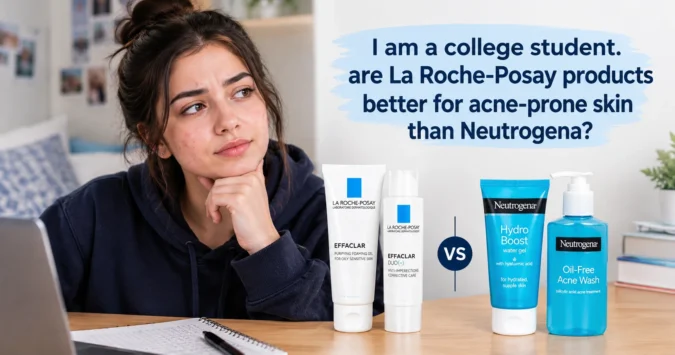

College life can make skincare difficult. Busy schedules, stress, changing routines, and limited budgets can make it tempting to choose a well-known acne product and hope it works. If you have acne-prone skin, you may be wondering: are La Roche-Posay products better for acne-prone skin than Neutrogena?
The answer depends less on the brand name and more on the specific product, active ingredient, skin type, and type of acne you are trying to manage. Both brands offer acne-focused products containing ingredients such as salicylic acid, benzoyl peroxide, and adapalene.
A useful skincare rule for students: the simplest routine you can use consistently is often easier to maintain than a complicated one.
La Roche-Posay vs. Neutrogena for Acne
Neither brand is automatically better for every person. La Roche-Posay’s Effaclar range includes products designed for acne-prone and oily skin, including salicylic acid treatments, benzoyl peroxide treatments, and adapalene 0.1%.
Neutrogena also has a broad acne range. Its current products include salicylic acid cleansers, benzoyl peroxide treatments, adapalene 0.1%, acne patches, and products aimed at stubborn breakouts.
| Factor | La Roche-Posay | Neutrogena |
|---|---|---|
| Acne-focused range | Effaclar | Multiple acne ranges |
| Salicylic acid | Available | Available |
| Benzoyl peroxide | Available | Available |
| Adapalene 0.1% | Available | Available |
| Oily/acne-prone skin options | Yes | Yes |
| Sensitive-skin options | Some products | Some products |
| Best comparison method | Check active ingredients | Check active ingredients |
The important point is that two products from different brands can contain the same acne medication but have different supporting ingredients, textures, and tolerability.
Which Ingredients Matter Most?
Salicylic acid is commonly used in acne products because it helps exfoliate inside pores and can be useful for clogged pores, blackheads, and whiteheads. La Roche-Posay currently offers several salicylic-acid acne products, while Neutrogena also has numerous salicylic-acid cleansers and treatments.
Benzoyl peroxide is another established acne ingredient. Both brands offer benzoyl-peroxide products. La Roche-Posay currently lists an Effaclar treatment containing 5.5% benzoyl peroxide, while Neutrogena offers several benzoyl-peroxide treatments.
Adapalene 0.1% is a topical retinoid used to treat and prevent acne, particularly clogged pores, blackheads, and whiteheads. Both companies currently offer 0.1% adapalene products.
What Should a College Student Choose?
Budget and routine matter. A student does not necessarily need an expensive multi-step routine. Start by identifying the main concern: clogged pores, inflammatory pimples, oily skin, or sensitivity.
If you are comparing two products, look at the active ingredient and concentration first. Then consider fragrance, texture, moisturizing ingredients, and whether your skin becomes dry or irritated.
For example, Neutrogena’s Evenly Clear Acne Cleanser contains 2% salicylic acid and a PHA exfoliant. Meanwhile, La Roche-Posay offers Effaclar products with salicylic acid, benzoyl peroxide, and adapalene.
That makes a product-by-product comparison more useful than simply asking which brand is better.
Common Acne Skincare Mistakes
One common mistake is starting several strong acne treatments at the same time. If irritation develops, it becomes difficult to know which product caused it.
Another mistake is assuming that stronger treatment always means better results. Acne products can cause dryness, redness, or irritation, particularly when introduced too quickly.
Students should also avoid changing products every few days. Acne treatments generally need consistent use over time, and some treatments may take several weeks before their benefits become noticeable.
When Should You See a Dermatologist?
Persistent, painful, deep, or scarring acne may need professional evaluation. A dermatologist can identify the type and severity of acne and recommend treatment appropriate for your skin.
You should also seek professional advice if an over-the-counter routine repeatedly causes significant irritation or if your acne is affecting your daily life.
Conclusion
So, are La Roche-Posay products better for acne-prone skin than Neutrogena? There is no universal answer. Both brands offer evidence-based acne ingredients, including salicylic acid, benzoyl peroxide, and adapalene.
For a college student, the smarter comparison is the individual formula rather than the label on the bottle. Choose the active ingredient that matches your acne concern, introduce products carefully, keep the routine manageable, and give the treatment enough time to work.
Is La Roche-Posay good for acne-prone skin?
Yes. La Roche-Posay has an Effaclar range specifically designed for acne-prone and oily skin, including salicylic acid, benzoyl peroxide, and adapalene products.
Is Neutrogena good for acne-prone skin?
Yes. Neutrogena offers numerous acne products containing salicylic acid, benzoyl peroxide, and adapalene.
Which is better for blackheads, La Roche-Posay or Neutrogena?
The active ingredient matters more than the brand. Adapalene and salicylic acid are both commonly used in acne-focused products targeting clogged pores and blackheads.
Can college students use adapalene 0.1%?
Adapalene 0.1% is an over-the-counter acne treatment in the United States and is listed by La Roche-Posay for people aged 12 and older. Follow the product directions and seek professional advice if you have concerns about irritation or suitability.
Should I use several acne products together?
Not necessarily. Using multiple active treatments can increase the chance of irritation. A simple routine built around appropriate acne treatment, gentle skincare, and consistency is often easier to manage.
Sources
La Roche-Posay Acne Skincare Products
Neutrogena Acne Products & Treatments
Article generator
my article generator tool is chatgpt.com
Why don’t me write the article yourself? Please explain in detail.
I’m not very good at writing articles because I don’t have much experience with article writing. My English is also not very strong, so I write articles in my own way. However, I do some research for my articles and try to add useful information. If any of the information is not verified or accurate, I apologize.