VZ Stock Price: How to Read Verizon Stock, Dividends, and Investment Risks
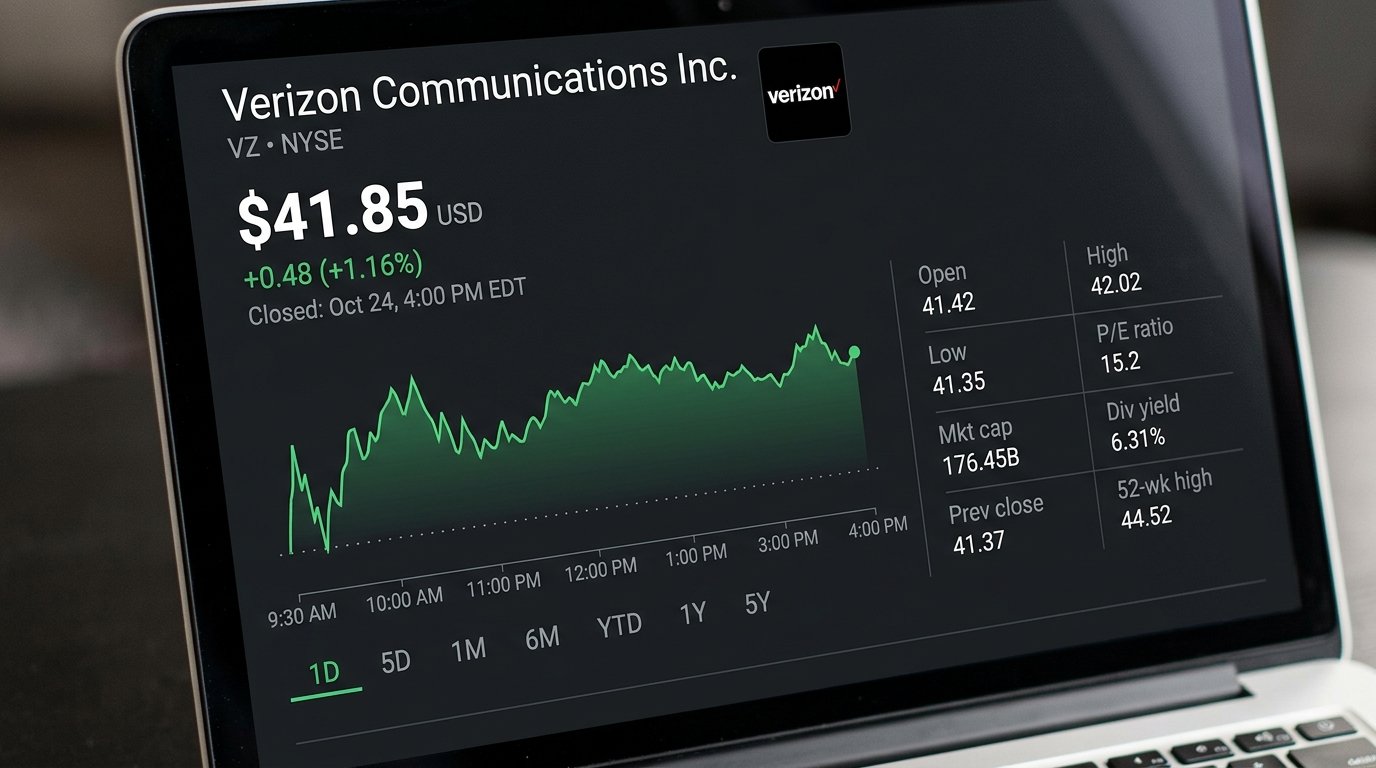
The VZ stock price is the market price of Verizon Communications Inc. (NYSE: VZ), one of the major wireless and broadband service providers in the United States. Investors often follow Verizon stock for its dividend income, steady demand for phone services, and potential for long-term returns. However, a high dividend yield or a low share price does not automatically make a stock a good investment.
To understand whether Verizon shares are attractive, investors need to look beyond the latest trading price. The most useful factors include quarterly earnings, free cash flow, dividend coverage, debt, customer growth, network spending, and the company’s ability to compete with other wireless providers.
The stock price changes throughout the trading day as investors respond to company results, interest rates, industry news, and expectations about future profits. Because market prices change constantly, the exact VZ stock price should be checked against a live market quote before making a trading decision. No unverified price is presented here as the current price on October 15, 2026.
VZ Stock Price Today: What Investors Should Know
As of October 15, 2026, the latest market report retrieved for this article is not a confirmed live quote for today. MarketWatch reported that Verizon shares closed at $46.35 on October 8, 2026, after gaining 1.27% that day. That figure is a historical closing price, not a guaranteed current trading price.

MarketWatch
For an up-to-date VZ stock quote, investors should check the latest available market price, the previous close, the daily trading range, and the time of the last update. A delayed quote may differ from the price available when an order is placed.
When reviewing Verizon stock today, pay attention to five key details:
- Current share price: The amount buyers are paying for one share at a particular time.
- Daily price change: Whether the stock is rising or falling compared with its previous close.
- Trading volume: How many shares have changed hands during the session.
- 52-week range: The highest and lowest prices over the past year.
- Upcoming earnings: Verizon’s published calendar lists its third-quarter 2026 earnings announcement for October 26, 2026. About Verizon
The earnings date matters because quarterly results can change investors’ expectations for revenue growth, profit margins, customer demand, and dividend safety.
A stock trading below its recent high is not automatically cheap. It may offer value, or it may reflect concerns about future earnings, debt, competition, or growth. The reasons behind the price movement matter more than the movement alone.
What Is Verizon Communications (VZ)?
Verizon Communications is a U.S. telecommunications company whose shares trade on the New York Stock Exchange under the ticker symbol VZ. Its business includes wireless phone services, broadband internet, fiber connections, and related communications products.
The company earns much of its revenue by serving consumers and businesses that pay recurring fees for connectivity. Wireless plans, internet subscriptions, business network services, and other communications products help generate cash over time.
This business model has two important features for investors.
First, people and businesses rely on phone and internet connections for everyday activities. That creates recurring demand, even when economic growth slows. Second, telecommunications networks require large, ongoing investments. Verizon must spend money to maintain coverage, improve capacity, upgrade equipment, and compete for customers.
As a result, VZ stock is often evaluated as an income-oriented telecommunications investment rather than a high-growth technology stock. That does not mean the share price cannot rise significantly. It means investors should pay close attention to the balance between recurring cash generation, network investment, dividends, and debt.
Verizon also competes in a market where customers can compare prices, switch providers, bundle services, or choose different internet technologies. Strong network coverage alone may not be enough to support long-term growth if competitors offer better value or attract customers with more appealing plans.
Verizon’s Latest Financial Performance
A useful starting point for analyzing VZ stock is the company’s reported financial performance, rather than predictions based on its share price alone.
Verizon’s 2025 annual results showed:
- Total operating revenue of $138.2 billion, compared with $134.8 billion in 2024.
- Reported earnings per share of $4.06.
- Adjusted earnings per share of $4.71, excluding specified special items.
- Operating cash flow of $37.1 billion.
- Free cash flow of $20.1 billion.
- Capital spending of $17.0 billion.
These figures were reported by Verizon in its 2025 financial results.
About Verizon
The numbers show why revenue, earnings, and cash flow need to be examined separately. Revenue increased, but revenue growth alone does not establish that a company is becoming more profitable or that its stock is undervalued.
Reported earnings also differ from adjusted earnings. Adjusted earnings exclude certain items under the company’s chosen reporting method. They can help investors understand ongoing operations, but they should not replace generally accepted accounting principles (GAAP) results. Investors should understand which expenses have been excluded before treating adjusted earnings as a measure of normal performance.
Free cash flow deserves particular attention. Verizon needs cash to fund network improvements, pay dividends, manage debt, and support other business priorities. A company may report accounting profits while still facing pressure on the cash available for these uses.
The next question is whether its more recent results support continued improvement.
What Verizon’s second-quarter 2026 results show
In its second-quarter 2026 results, Verizon reported several encouraging operating and cash-flow measures alongside areas that deserve attention.
The company reported adjusted earnings per share of $1.30, up 6.6% from $1.22 in the same quarter of 2025. However, reported earnings per share fell 22%, from $1.18 to $0.92. The difference shows why investors should examine both adjusted and reported results instead of relying on one headline number.
Verizon also reported second-quarter operating cash flow of $10.4 billion, up 16.3% year over year, and free cash flow of $6.4 billion, up 24.4%. For the first half of 2026, free cash flow reached $10.2 billion, compared with $8.8 billion in the first half of 2025.
SEC
These results are useful signs of cash-generation strength. They do not guarantee that future quarters will be as strong, and one quarter should not be treated as a long-term forecast.
Investors should look at whether these gains continue, whether they result from sustainable operations, and whether the company can meet its capital needs without taking on excessive financial risk.
VZ Stock Dividend: Yield, Payments, and Sustainability
The Verizon dividend is one of the main reasons investors research VZ stock. Dividend payments can provide cash income while an investor holds shares, but the amount received and the future value of the investment are not guaranteed.
On September 9, 2026, Verizon declared a quarterly dividend of $0.7075 per share, payable on November 2, 2026, to shareholders of record as of October 9, 2026. The declared amount was unchanged from the previous quarter.
About Verizon
At that rate, four equal quarterly payments would total $2.83 per share over a year. This is an annualized rate, not a promise that all four payments will be made at that amount.
How to calculate the VZ dividend yield
Dividend yield estimates how much a stock pays in annual dividends relative to its share price.
The formula is:
Dividend Yield=Share PriceAnnual Dividend Per Share×100
For example, using the annualized dividend of $2.83 and the historical October 8 closing price of $46.35:
$46.35$2.83×100≈6.10%
This is an illustrative calculation based on a historical share price, not the current VZ dividend yield on October 15, 2026. The yield changes whenever the share price changes, even if the dividend remains the same.
A falling stock price can make a dividend yield look more attractive. However, the decline may also reflect worries about the company’s business or ability to maintain its payout.
For this reason, investors should avoid choosing a stock based on dividend yield alone.
Is Verizon’s dividend sustainable?
Dividend sustainability depends on the company’s ability to generate enough cash to meet its obligations while continuing to invest in its business.
Verizon paid approximately $11.5 billion in dividends during 2025. Its reported free cash flow for that year was $20.1 billion. These figures suggest that annual free cash flow exceeded the cash paid in dividends during 2025, although the comparison does not guarantee future coverage.
SEC
+1
Investors should monitor several factors:
- Free cash flow: Does the company generate enough cash after capital spending?
- Dividend payout ratio: How much of reported earnings is being distributed to shareholders?
- Cash dividend coverage: How much free cash flow remains after dividend payments?
- Debt obligations: How much cash must be used for interest and repayments?
- Management’s capital priorities: Is the company balancing shareholder returns with network investment and financial stability?
The distinction between earnings coverage and cash-flow coverage matters. Depreciation, capital expenditure, working capital, and other items can make accounting profit differ from cash available for dividends.
A company can maintain a dividend during a difficult period, but doing so may leave less money for debt reduction or future investment. If cash flow weakens for long enough, management may need to reconsider the payout.
The practical takeaway: Verizon’s dividend history is relevant, but the strongest case for an income investment comes from sustainable cash generation, not from a long record of increases alone.
Why the VZ Stock Price Goes Up or Down
The VZ share price reflects investors’ expectations about Verizon’s future financial performance. Those expectations can change even when the company has not yet reported a major change in its business.
1. Quarterly earnings and financial guidance
Earnings reports often influence Verizon stock because they provide fresh information about revenue, profits, customers, cash flow, and management’s outlook.
A company can report higher earnings and still see its share price fall if investors expected even better results. Likewise, a modest result may be received positively if it is stronger than expected or management raises its forecast.
Investors should therefore compare reported results with previous periods, company guidance, and market expectations. The direction of earnings alone does not explain every price movement.
2. Wireless customer growth and competition
Verizon competes with other large U.S. wireless carriers, including AT&T and T-Mobile. Its ability to attract new customers and keep existing ones can affect future revenue.
Important measures include postpaid phone net additions, customer churn, average revenue per account, and service revenue growth.
Postpaid phone net additions measure the net change in a particular customer category after additions and losses. Customer churn measures the rate at which customers leave. Both provide information that total revenue may not reveal immediately.
If Verizon attracts customers without relying too heavily on discounts, it may be better positioned to protect revenue and margins. If it must spend more on promotions to prevent customers from switching, revenue could grow while profitability comes under pressure.
3. Interest rates and bond yields
Interest rates can influence the VZ stock price in two main ways.
First, higher borrowing costs can make it more expensive for companies to refinance debt or fund future investments. Second, higher yields on government bonds and other relatively lower-risk assets can make dividend-paying stocks less attractive to some income investors.
When bond yields fall, investors seeking income may become more interested in dividend stocks. However, the relationship is not automatic. Business results, market sentiment, and company-specific risks can outweigh interest-rate effects.
4. Debt and credit conditions
Telecommunications companies need substantial capital to build and maintain networks. Verizon’s debt levels therefore matter when assessing its financial flexibility.
At the end of the second quarter of 2026, Verizon reported total debt of approximately $165.2 billion and net unsecured debt of approximately $128.7 billion. Its net unsecured debt-to-adjusted EBITDA ratio was 2.5 times, using the company’s stated measure.
SEC
These figures provide context, but they should not be read in isolation. Investors need to consider debt maturity dates, interest costs, cash balances, refinancing needs, and the cash flow available to service obligations.
A high debt balance does not automatically mean a company is in financial trouble. The concern is whether its earnings and cash generation are sufficient to support that debt without restricting important business decisions.
5. Network investment and broadband expansion
Verizon must invest in wireless infrastructure, spectrum, fiber, and related technology to remain competitive. Such investment can support better service and future revenue, but it also consumes cash.
Broadband expansion may offer opportunities to sell multiple services to the same customer. Yet the value of that expansion depends on construction costs, customer take-up, pricing, and the time required to recover the investment.
Investors should distinguish between spending that creates a realistic path to stronger future cash flow and spending that produces limited returns.
6. Economic conditions and market sentiment
Changes in employment, household budgets, business spending, and overall market confidence can affect telecommunications stocks.
Phone and internet services are important to many households, which can make demand more resilient than demand for some optional purchases. Still, customers may downgrade plans, delay upgrades, or switch providers to reduce bills.
Broad market declines can also pull down Verizon shares even when the company has not released negative news. This is why investors should separate company-specific developments from movements across the stock market.
Is VZ Stock Undervalued?
There is no single share price that proves Verizon is cheap or expensive. Valuation depends on the company’s future earnings, cash flow, growth prospects, financial risks, and the return investors expect.
A stock may trade at a lower price than it did last year and still be expensive relative to its expected earnings. Another stock may trade near a recent high while remaining reasonably valued if its long-term financial outlook has improved.
For VZ stock, three valuation measures are particularly useful.
Price-to-earnings ratio
The price-to-earnings ratio, or P/E ratio, compares a share price with earnings per share.
P/E Ratio=Earnings Per ShareShare Price
A lower P/E ratio can indicate a lower valuation, but it may also reflect expectations of weak growth or higher risk. Investors should check whether the calculation uses trailing earnings, forward earnings estimates, reported EPS, or adjusted EPS.
Comparing Verizon’s P/E ratio with those of AT&T and T-Mobile can provide context, but the comparison is most useful when differences in business mix, growth, debt, and earnings quality are considered.
Price-to-free-cash-flow ratio
The price-to-free-cash-flow ratio compares a company’s market value with the cash it generates after capital spending.
This measure can be useful for a capital-intensive business because network investment is a major part of the economics of telecommunications.
However, investors should use a consistent definition of free cash flow and examine several years of results. A single strong quarter may not represent the company’s normal cash-generating ability.
Dividend yield compared with financial strength
A high yield may be attractive to investors seeking income, but it should be assessed alongside dividend coverage, debt, and future earnings.
A lower-yielding company may offer stronger growth or lower financial risk. A higher-yielding company may provide more current income but less room for error if cash flow weakens.
The right comparison depends on the investor’s goals. Someone who needs reliable income may place more weight on dividend coverage, while someone seeking capital appreciation may focus more on growth and valuation.
Verizon Stock vs. AT&T and T-Mobile
Investors often compare VZ stock with AT&T stock and T-Mobile US stock because all three companies compete in the U.S. wireless market. However, they do not have identical business models, financial profiles, or investment priorities.
| Investment factor | Verizon (VZ) | AT&T (T) | T-Mobile (TMUS) |
|---|---|---|---|
| Main focus | Wireless, broadband, and fiber | Wireless, fiber, and connectivity services | Wireless and broadband |
| Dividend analysis | Examine payout coverage and cash flow | Examine payout coverage and debt | Assess the dividend in the context of its broader capital-return approach |
| Growth drivers | Customer retention, service revenue, broadband expansion | Wireless customers, fiber growth, service revenue | Customer growth, service revenue, and broadband expansion |
| Main financial checks | Cash flow, debt, network spending | Cash flow, debt, network spending | Customer growth, profitability, investment, and valuation |
This is a broad comparison, not a ranking of current investment quality. The relative attractiveness of the three stocks can change as their share prices, financial results, and business strategies evolve.
For a fair comparison, use financial statements from the same reporting period and calculate valuation measures using consistent methods. Also account for differences in share prices, dividend policies, outstanding shares, and the amount of debt each company carries.
An investor interested mainly in income may reach a different conclusion from an investor seeking faster earnings growth. Neither approach is automatically better; the key is to match the investment to a clear goal.
How to Analyze VZ Stock Before Buying
A good investment decision starts with a clear process. Rather than trying to predict every daily price movement, investors can review a few important measures and decide whether the stock fits their financial goals.
Step 1: Check the latest share price
Start with the current VZ stock quote. Confirm the date, time, currency, and whether the figure is a live price or a delayed quote.
Then review the previous close, recent price trend, 52-week range, and trading volume. These details help put the current price into context, but they do not establish whether the stock is fairly valued.
Step 2: Review the latest earnings report
Read Verizon’s latest quarterly results and compare them with the same quarter a year earlier.
Focus on:
- Service revenue and total operating revenue.
- Reported and adjusted earnings per share.
- Wireless customer additions and customer losses.
- Operating cash flow and free cash flow.
- Management’s updated financial guidance.
Look for consistent trends rather than relying on one favorable headline. Revenue growth accompanied by stronger cash flow may be more encouraging than revenue growth accompanied by falling margins and rising costs.
Step 3: Calculate the dividend yield
Use the latest declared annualized dividend and the current share price to calculate the indicated yield.
Then ask whether the dividend is supported by cash flow. Review dividend payments, capital expenditure, interest costs, and debt repayments together.
Remember that the indicated yield can change quickly if the stock price moves. It can also change if the board raises, maintains, or cuts the dividend.
Step 4: Assess debt and financial flexibility
Review Verizon’s latest balance sheet, debt maturity schedule, and interest expenses.
A useful question is whether the company can continue investing in its network, paying its dividend, and meeting debt obligations if revenue growth slows.
Pay attention to changes in net debt, leverage ratios, and the amount of cash remaining after major commitments. Avoid treating any one debt ratio as a complete measure of financial health.
Step 5: Compare valuation with competitors
Compare Verizon with AT&T and T-Mobile using current market prices and financial reports from comparable periods.
Look at P/E ratios, free cash flow, dividend yield, earnings growth, and debt. A lower valuation may present an opportunity, but only if the company’s financial outlook justifies it.
Step 6: Decide what would change your view
Before buying, identify the conditions that would make you reconsider the investment.
For example, you might watch for weaker cash flow, declining customer retention, rising leverage, or evidence that the dividend is becoming harder to fund. You should also identify the positive developments that would support your original investment case.
This approach is more useful than setting a target price based only on a recent high or low.
What Are the Main Risks of Investing in VZ Stock?
Verizon operates an established business, but its shares are not risk-free. Investors should consider the following issues before buying.
Slower growth
A mature telecommunications business may have fewer opportunities for rapid expansion than a younger company in a fast-growing industry. Verizon can grow through new customers, higher-value plans, broadband expansion, and improved efficiency, but those gains are not guaranteed.
If growth falls short of expectations, investors may be less willing to pay the same valuation for its shares.
High capital requirements
Wireless networks and fiber infrastructure require ongoing spending. If network costs rise or projects produce weaker returns than expected, free cash flow may come under pressure.
This matters because free cash flow helps support dividends, debt reduction, and other uses of capital.
Competition and pricing pressure
Verizon faces competitors that can use discounts, bundled services, device promotions, and network improvements to attract customers.
Aggressive competition may force Verizon to spend more on customer acquisition or accept lower revenue per customer. Even if the company retains its customer base, weaker pricing power can affect profitability.
Dividend risk
A dividend is declared by the company’s board and is not a contractual payment to common shareholders.
If cash generation deteriorates or financial needs change, the board can reduce or suspend future payments. A dividend cut can also cause the share price to fall, affecting investors who expected both income and capital stability.
Interest-rate and refinancing risk
Verizon’s debt creates exposure to borrowing costs and refinancing conditions. Higher rates can make new borrowing more expensive, while a large amount of debt coming due can increase financial pressure.
The effects depend on the timing of maturities, existing financing terms, available cash, and future operating performance.
Unexpected business or market events
Regulatory changes, service disruptions, cyber incidents, technology shifts, and broader market volatility can all affect investor expectations.
Not every risk will affect the stock at the same time. The purpose of reviewing them is to understand what could weaken the investment case, not to predict that a particular problem will occur.
VZ Stock Forecast: What Could Influence Its Future Price?
A responsible Verizon stock forecast should be based on possible business outcomes, not a guaranteed price target.
Three broad scenarios help explain what investors might watch over the coming quarters.
Positive scenario
Verizon sustains customer growth, improves service revenue, generates strong free cash flow, and manages debt effectively. If results exceed investor expectations, the shares could benefit from stronger earnings expectations and a higher valuation.
Middle scenario
Revenue and earnings grow slowly, the dividend remains supported, and debt declines only gradually. In this case, total returns may depend heavily on dividend income and modest changes in the share price.
Negative scenario
Competition weakens pricing, cash flow declines, or debt and network costs limit financial flexibility. Investors could lower their expectations for future earnings, putting pressure on the share price and potentially the dividend.
These are illustrative scenarios, not predictions or probability-weighted forecasts. The actual outcome will depend on future results, market conditions, and developments that cannot be known in advance.
The next important scheduled event is Verizon’s third-quarter 2026 earnings announcement on October 26. Investors can use that report to assess whether the trends seen in the first half of the year are continuing.
About Verizon
+1
Rather than treating an analyst price target as a promise, compare any forecast with its underlying assumptions. Ask what revenue growth, profit margins, free cash flow, and valuation would be required to justify the target.
Frequently Asked Questions
What is the VZ stock symbol?
VZ is the ticker symbol for Verizon Communications Inc., which trades on the New York Stock Exchange. The company provides wireless, broadband, fiber, and related communications services.
Is VZ stock a good buy right now?
That depends on the current share price, valuation, dividend coverage, debt, business outlook, and your investment goals. Verizon may interest income-focused investors, but its dividend and share price are not guaranteed. Review the latest earnings and cash-flow figures before deciding.
Does Verizon pay dividends every month?
No. Verizon’s common stock dividend is paid quarterly, subject to board approval and the company’s declared payment schedule. The September 2026 declaration set the next payment for November 2, 2026, for shareholders of record on October 9, 2026.
About Verizon
Can the VZ stock price fall even if Verizon pays its dividend?
Yes. Dividends do not prevent share-price declines. If investors become concerned about growth, competition, debt, or future earnings, the stock can fall even while the dividend remains unchanged.
What should investors watch before Verizon’s next earnings report?
Review service revenue, customer additions and churn, reported and adjusted earnings per share, free cash flow, debt, dividend coverage, and updated management guidance. Compare the new results with the same quarter a year earlier and the company’s previous outlook.
Conclusion
The VZ stock price tells investors what the market currently values Verizon shares at, but it does not tell the whole investment story. Verizon’s recurring service revenue and dividend may appeal to income-focused investors, while its debt, network spending, competition, and growth outlook remain important considerations.
The most useful way to assess Verizon stock is to combine the latest market quote with current financial results, cash-flow analysis, dividend coverage, and a fair comparison with competing companies. Check the next earnings report before drawing conclusions about the company’s direction, and remember that even a well-supported investment case cannot eliminate the risk of losing money.