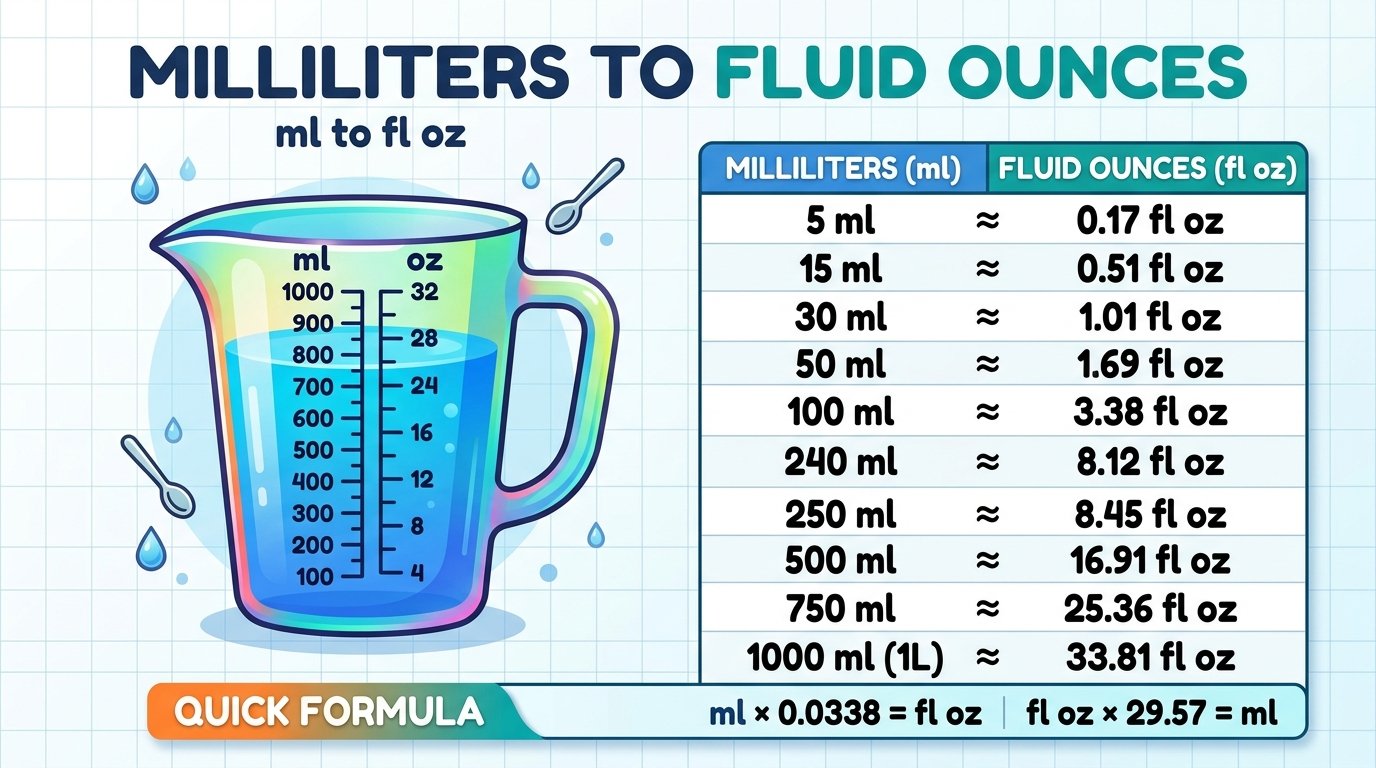
ML to OZ: How to Convert Milliliters to Ounces
Converting ml to oz means changing milliliters into fluid ounces. This is useful when you follow a recipe, measure drinks, check a bottle size, or compare liquid amounts. The calculation is simple: for US fluid ounces, divide the number of milliliters by 29.5735.
For example, 100 ml is about 3.38 US fluid ounces, while 250 ml is about 8.45 US fluid ounces. If you have 500 ml of water, that is about 16.91 US fluid ounces.
There is one important detail: the US fluid ounce and the UK (Imperial) fluid ounce are not the same size. You need to choose the right one for your recipe, product, or measurement.
This guide explains the ml to oz formula, gives you a useful conversion chart, and shows you how to convert common amounts without a calculator.
What Does ML to OZ Mean?
ML to oz is a common way to describe the conversion from milliliters to ounces.
A milliliter (ml or mL) is a metric unit used to measure liquid volume. You may see it on water bottles, milk cartons, medicine cups, cooking tools, and drink containers.
A fluid ounce (fl oz) is a unit of liquid volume used in the United States and the United Kingdom. However, the two countries use different fluid-ounce sizes.
These units measure volume, not weight. This difference matters because 100 ml of a liquid does not always weigh 100 grams. The weight depends on the liquid’s density.
For example, a bottle labeled 250 ml tells you how much space the liquid takes up. It does not mean the liquid weighs 250 grams.
When a recipe or bottle label uses ml and you need ounces, you can convert the number using the correct formula.
How Many Ounces Are in 1 ML?
One milliliter equals approximately 0.0338 US fluid ounces.
To convert milliliters to US fluid ounces, divide the ml amount by 29.5735. This is the standard US conversion factor published by the National Institute of Standards and Technology (NIST).

NIST
+1
Here are a few examples:
- 1 ml = 0.034 US fl oz
- 5 ml = 0.169 US fl oz
- 10 ml = 0.338 US fl oz
- 15 ml = 0.507 US fl oz
- 30 ml = 1.014 US fl oz
- 100 ml = 3.381 US fl oz
These values are rounded for easy reading. For most everyday tasks, two decimal places are enough. For scientific work or precise measurements, keep more decimal places until the final result.
Remember that the answer changes slightly if you use UK Imperial fluid ounces instead of US fluid ounces.
ML to OZ Conversion Formula
The easiest way to convert milliliters to US fluid ounces is to use this formula:
US fl oz=mL29.5735\text{US fl oz}=\frac{\text{mL}}{29.5735}US fl oz=29.5735mL
In simple words, divide the number of milliliters by 29.5735 to get the amount in US fluid ounces.
Example 1: Convert 100 ml to oz
Suppose you have a 100 ml bottle of juice and want to know its size in US fluid ounces.
Step 1: Write the amount in milliliters.
100 ml
Step 2: Divide by 29.5735.
100÷29.5735≈3.38100\div29.5735\approx3.38100÷29.5735≈3.38
Answer: 100 ml = 3.38 US fluid ounces.
Example 2: Convert 250 ml to oz
Use the same formula:
250÷29.5735≈8.45250\div29.5735\approx8.45250÷29.5735≈8.45
Answer: 250 ml = 8.45 US fluid ounces.
Example 3: Convert 500 ml to oz
A 500 ml water bottle is a common size in many countries.
500÷29.5735≈16.91500\div29.5735\approx16.91500÷29.5735≈16.91
Answer: 500 ml = 16.91 US fluid ounces.
You can use this method for any amount of liquid. Just replace the example number with your own measurement.
ML to OZ Conversion Chart
The following chart shows common milliliter amounts and their approximate equivalents in US fluid ounces.
| Milliliters (ml) | US fluid ounces (fl oz) |
|---|---|
| 1 ml | 0.03 oz |
| 5 ml | 0.17 oz |
| 10 ml | 0.34 oz |
| 15 ml | 0.51 oz |
| 20 ml | 0.68 oz |
| 25 ml | 0.85 oz |
| 30 ml | 1.01 oz |
| 45 ml | 1.52 oz |
| 50 ml | 1.69 oz |
| 60 ml | 2.03 oz |
| 75 ml | 2.54 oz |
| 90 ml | 3.04 oz |
| 100 ml | 3.38 oz |
| 120 ml | 4.06 oz |
| 125 ml | 4.23 oz |
| 150 ml | 5.07 oz |
| 180 ml | 6.09 oz |
| 200 ml | 6.76 oz |
| 240 ml | 8.12 oz |
| 250 ml | 8.45 oz |
| 300 ml | 10.14 oz |
| 350 ml | 11.83 oz |
| 400 ml | 13.53 oz |
| 450 ml | 15.21 oz |
| 500 ml | 16.91 oz |
| 600 ml | 20.29 oz |
| 700 ml | 23.67 oz |
| 750 ml | 25.36 oz |
| 1,000 ml | 33.81 oz |
The chart uses US fluid ounces. Results are rounded to two decimal places, so small differences may appear if you use a calculator with more decimal places.
How to Convert ML to OZ Without a Calculator
You do not always need a calculator to make a useful estimate. If you only need an approximate amount for cooking or drinking, you can use a simple shortcut.
Divide the milliliter amount by 30. The result will be close to the number of US fluid ounces.
For example:
- 30 ml is about 1 oz.
- 60 ml is about 2 oz.
- 150 ml is about 5 oz.
- 300 ml is about 10 oz.
- 600 ml is about 20 oz.
This shortcut works because one US fluid ounce is approximately 29.57 ml, which is close to 30 ml.
However, this method gives an estimate rather than an exact result. If you are measuring medicine, preparing a scientific solution, or following a recipe that needs precise measurements, use the full conversion factor.
A Simple Mental Math Trick
For a quick estimate, remember that 30 ml is about 1 US fluid ounce.
If you have 90 ml, think of it as three portions of 30 ml. That gives you about 3 oz.
If you have 240 ml, divide it by 30. The estimate is 8 oz. The more precise result is about 8.12 US fluid ounces.
This shortcut is easy to remember and works well for many everyday liquid measurements.
Common ML to OZ Conversions for Water Bottles
Water bottles come in many sizes. Their labels may show milliliters, liters, fluid ounces, or more than one unit.
Understanding these measurements helps you compare bottle sizes when shopping, traveling, or tracking how much water you drink.
250 ml water bottle
A 250 ml bottle holds about 8.45 US fluid ounces.
This is a small serving of water or another drink. It is also a useful amount to recognize when measuring liquid ingredients.
330 ml water bottle
A 330 ml bottle holds about 11.16 US fluid ounces.
This size is common for individual drinks in some markets. The actual container size depends on the product and country.
500 ml water bottle
A 500 ml bottle holds about 16.91 US fluid ounces.
This is a convenient size for carrying water to school, work, the gym, or on a short trip.
750 ml water bottle
A 750 ml bottle holds about 25.36 US fluid ounces.
This is three-quarters of a liter. It is useful to recognize when comparing larger drink containers.
1 liter water bottle
One liter contains 1,000 ml.
To convert it into US fluid ounces:
1000÷29.5735≈33.811000\div29.5735\approx33.811000÷29.5735≈33.81
Therefore, 1 liter is about 33.81 US fluid ounces.
A liter is slightly less than 34 US fluid ounces.
ML to OZ for Cooking and Baking
Cooking is one of the main reasons people search for milliliter-to-ounce conversions. Recipes from different countries may use different measurement systems.
For example, a recipe might ask for 200 ml of milk, while your measuring cup uses fluid ounces. You can convert the amount instead of guessing.
Here are some useful cooking examples.
Milk
If a recipe calls for 200 ml of milk, divide 200 by 29.5735.
The result is about 6.76 US fluid ounces.
Water
If you need 300 ml of water, the amount is about 10.14 US fluid ounces.
For a simple recipe, you might measure approximately 10.1 fluid ounces. For more exact baking, follow the recipe’s intended measurement system as closely as possible.
Cooking oil
If a recipe needs 100 ml of cooking oil, that equals about 3.38 US fluid ounces.
Remember that this is a volume conversion. The oil’s weight in ounces will be different from its volume in fluid ounces.
Lemon juice
If you need 50 ml of lemon juice, divide 50 by 29.5735.
The answer is approximately 1.69 US fluid ounces.
Syrups and sauces
The same formula works for liquid syrups, sauces, and other pourable ingredients. However, a fluid-ounce measurement tells you the volume, not the weight.
For baking, this distinction can matter. If a recipe gives a weight in ounces rather than a volume in fluid ounces, you need a weight measurement or a suitable density conversion.
US Fluid Ounces vs. UK Imperial Fluid Ounces
One of the most common mistakes in liquid conversion is treating all fluid ounces as equal.
The United States uses the US customary system. The United Kingdom uses the Imperial system for certain measurements. Their fluid ounces have different sizes.
- 1 US fluid ounce is approximately 29.5735 ml.
- 1 UK Imperial fluid ounce is approximately 28.4131 ml.
This means that the same amount in milliliters produces a slightly different number of ounces, depending on the system you choose.
For example, 100 ml is approximately 3.38 US fluid ounces, but it is approximately 3.52 UK Imperial fluid ounces.
The difference may seem small, but it can affect larger measurements and recipes.
Which fluid ounce should you use?
Use US fluid ounces if you are following a US recipe or reading a product label that uses US customary measurements.
Use Imperial fluid ounces if a British recipe specifically calls for Imperial fluid ounces.
If the recipe only says “oz,” check whether it means fluid ounces or ounces by weight. These are different measurements, and the context alone may not always be enough to tell you which one is intended.
When accuracy matters, check the recipe notes, packaging, or measuring equipment before converting.
The Difference Between ML, OZ, and FL OZ
These abbreviations can look similar, but they do not always mean the same thing.
What is ml?
ML, more commonly written as mL, stands for milliliter. It measures volume.
You may find it on beverage labels, cooking instructions, liquid medicine packaging, and personal care products.
What is fl oz?
Fl oz stands for fluid ounce. It measures volume rather than weight.
For example, a bottle marked 16 fl oz tells you the volume of liquid inside, subject to the product’s labeling rules.
What is oz?
The abbreviation oz can refer to an ounce of weight. On some liquid products, the label may instead use fluid ounces to show volume.
One ounce by weight equals approximately 28.35 grams. A US fluid ounce, by contrast, measures approximately 29.57 ml.
These values are different because mass and volume measure different things.
Why does the difference matter?
Imagine you have a bottle of cooking oil.
If you measure 100 ml, you are measuring its volume. If you put the oil on a scale, you are measuring its mass.
The two measurements are related, but they are not interchangeable without knowing the oil’s density.
This distinction is important for cooking, baking, shipping, product packaging, and laboratory work.
How to Convert Large ML Amounts to OZ
The same formula works for large and small amounts. You do not need a different method for liters or large bottles.
Convert the amount into milliliters first if it is given in liters. Then divide by 29.5735 to get US fluid ounces.
1.5 liters to oz
One liter equals 1,000 ml, so 1.5 liters equals 1,500 ml.
1500÷29.5735≈50.721500\div29.5735\approx50.721500÷29.5735≈50.72
Therefore, 1.5 liters is about 50.72 US fluid ounces.
2 liters to oz
Two liters equals 2,000 ml.
2000÷29.5735≈67.632000\div29.5735\approx67.632000÷29.5735≈67.63
Therefore, 2 liters is about 67.63 US fluid ounces.
3 liters to oz
Three liters equals 3,000 ml.
3000÷29.5735≈101.443000\div29.5735\approx101.443000÷29.5735≈101.44
Therefore, 3 liters is about 101.44 US fluid ounces.
5 liters to oz
Five liters equals 5,000 ml.
5000÷29.5735≈169.075000\div29.5735\approx169.075000÷29.5735≈169.07
Therefore, 5 liters is about 169.07 US fluid ounces.
These calculations are useful for comparing large drink containers, measuring water supplies, and checking liquid quantities.
How to Convert OZ Back to ML
Sometimes you may need to reverse the conversion. For example, a recipe may give a measurement in fluid ounces, but your measuring jug uses milliliters.
In that case, multiply US fluid ounces by 29.5735.
mL=US fl oz×29.5735\text{mL}=\text{US fl oz}\times29.5735mL=US fl oz×29.5735
For example, to convert 8 US fluid ounces to milliliters:
8×29.5735≈236.598\times29.5735\approx236.598×29.5735≈236.59
The answer is approximately 236.59 ml.
Here are some other examples:
- 1 US fl oz = 29.57 ml
- 2 US fl oz = 59.15 ml
- 4 US fl oz = 118.29 ml
- 8 US fl oz = 236.59 ml
- 12 US fl oz = 354.88 ml
- 16 US fl oz = 473.18 ml
- 32 US fl oz = 946.35 ml
Use this reverse formula whenever you need to convert fluid ounces into milliliters.
Common Mistakes When Converting ML to OZ
A few simple errors can lead to the wrong answer. Checking your units before calculating can help you avoid them.
1. Using the wrong conversion factor
The US fluid ounce and the UK Imperial fluid ounce are different sizes.
If your recipe uses US fluid ounces, divide the milliliter amount by 29.5735. If it uses UK Imperial fluid ounces, divide by approximately 28.4131.
2. Confusing fluid ounces with weight ounces
Fluid ounces measure volume. Ounces by weight measure mass.
Do not assume that 8 fluid ounces of every liquid weighs 8 ounces. The result depends on the liquid’s density.
3. Rounding too early
If you round each step of a calculation, small errors can add up.
Keep several decimal places during the calculation, then round the final answer to the level of accuracy you need.
For everyday cooking, two decimal places are often enough. For technical work, follow the required precision.
4. Forgetting to convert liters into milliliters
One liter equals 1,000 ml.
If you need to convert 2 liters to US fluid ounces, first calculate 2 × 1,000 = 2,000 ml. Then divide 2,000 by 29.5735.
This gives about 67.63 US fluid ounces.
5. Assuming every measuring cup is the same
Measuring cups may use milliliters, US cups, Imperial units, or other markings. Check the labels before pouring.
A US cup is approximately 236.59 ml, while other cup standards may differ. If a recipe requires an exact amount, use the unit specified by the recipe.
Frequently Asked Questions
How many oz is 100 ml?
100 ml is approximately 3.38 US fluid ounces. For UK Imperial fluid ounces, the same amount is about 3.52 fl oz.
How many oz is 250 ml?
250 ml is approximately 8.45 US fluid ounces. This is slightly more than one US cup, which holds about 236.59 ml.
How many oz is 500 ml?
500 ml is approximately 16.91 US fluid ounces. This is a common size for bottled water and other drinks.
How many ml are in 1 oz?
One US fluid ounce equals approximately 29.5735 ml. One UK Imperial fluid ounce equals approximately 28.4131 ml. Check which system you need before converting.
Is 30 ml equal to 1 oz?
Not exactly. Thirty milliliters is about 1.014 US fluid ounces. However, 30 ml is close enough to 1 US fluid ounce for many rough estimates.
How many oz are in 1 liter?
One liter equals 1,000 ml, which is approximately 33.81 US fluid ounces or 35.20 UK Imperial fluid ounces.
How do I convert ml to oz quickly?
For US fluid ounces, divide milliliters by 29.5735. For a quick estimate, divide by 30. The estimate is useful for everyday tasks, but use the full factor when precision matters.
Does ml to oz measure weight?
No. Milliliters and fluid ounces measure volume. Ounces by weight measure mass. To convert the volume of a liquid into its weight, you need to know its density.
Why does my conversion calculator show a different result?
The calculator may use a different fluid-ounce standard, display more decimal places, or round the answer differently. Check whether it uses US or UK Imperial fluid ounces.
Can I use this formula for medicine?
The mathematical conversion works for liquid volume, but medicine doses must be measured with care. Follow the medicine label or a health professional’s instructions, and use an appropriate marked dosing device. Do not rely on a rough mental estimate for medication.
Conclusion
Converting ml to oz is simple once you know which fluid-ounce system to use. For US fluid ounces, divide milliliters by 29.5735. For UK Imperial fluid ounces, use approximately 28.4131 ml per fluid ounce.
A few common values are worth remembering: 100 ml is about 3.38 US fl oz, 250 ml is about 8.45 US fl oz, 500 ml is about 16.91 US fl oz, and 1,000 ml is about 33.81 US fl oz.
Use the conversion chart for quick reference, the formula for precise calculations, and the correct unit for your recipe or product. These simple steps make it easier to measure liquids accurately at home, at school, or at work.
Sources
ml to oz Converter
Convert ml to oz – Conversion of Measurement Units