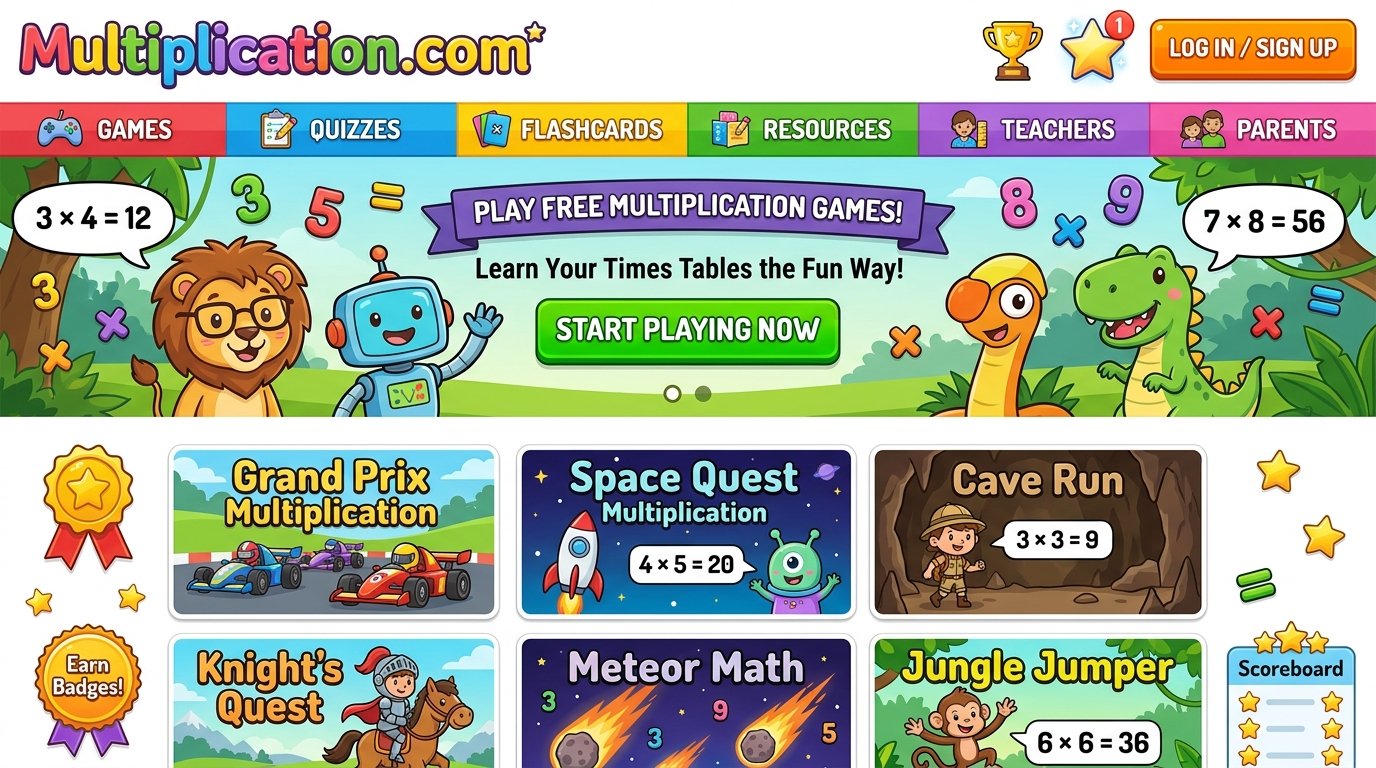
Multiplication.com: A Complete Guide to Free Math Games, Times Tables, and Learning Resources
Multiplication.com is an online learning website that helps children understand multiplication, practice times tables, and build confidence with basic math. It offers interactive multiplication games, step-by-step lessons, self-checking quizzes, flashcards, printable worksheets, and resources for parents and teachers. Its main purpose is to help students move beyond guessing answers and develop a stronger grasp of multiplication facts through guided learning and regular practice.
For families in the United States, the website can be a useful extra resource for elementary math at home. Teachers can also use its activities to support classroom lessons, review skills, and give students more practice. However, the best results come from choosing activities that match a child’s current ability rather than relying on games alone.
What Is Multiplication.com?
Multiplication.com is an educational website focused on multiplication facts and related basic math skills. It combines lessons, visual learning activities, online games, quizzes, and printable materials in one place.
The website is owned by IXL Learning, Inc., according to its published privacy policy. Its stated purpose is to help children learn math facts with support from teachers and parents.
Unlike a general math website that covers many subjects at once, Multiplication.com puts a strong emphasis on learning and remembering multiplication facts. Students can work on individual facts, review times tables, practice through games, and check their progress with quizzes.
The site also offers resources beyond multiplication, including activities for addition, subtraction, and division. This makes it useful for children who need to strengthen several basic arithmetic skills.
A child who is learning the six times table, for example, can begin with a lesson or visual memory activity, move to practice questions, and then try a quiz to see which answers are becoming easier to recall.
The key benefit is that learning and practice are connected. Instead of using a game without understanding the math behind it, a student can work through several types of activities that support the same skill.
Key Features of Multiplication.com
The website brings together different ways to learn, practice, and check basic math skills. Each resource serves a different purpose, so students do not have to use the same learning method every time.
1. Online Multiplication Games
Multiplication games are one of the site’s main attractions. They give students a more active way to practice arithmetic than completing a page of sums alone.The games are designed to help children improve speed and accuracy while working with multiplication facts. Depending on the activity, students may answer questions, solve problems, or use their knowledge to progress through a game.
This format can be helpful for children who lose interest during repeated drills. A clear goal, quick feedback, and a chance to try again can make practice feel less like a chore.
For example, a student learning the seven times table can use a multiplication game to answer questions such as:
- 7 × 2 = 14
- 7 × 5 = 35
- 7 × 8 = 56
- 7 × 9 = 63
As the child becomes more comfortable with these facts, practice can help make the answers easier to recall.
The website also provides games for addition, subtraction, and division. These activities can help children review earlier skills and see how the four basic operations relate to one another.
One important point: a child should not be judged only by how quickly they finish a game. Correct answers, understanding, and steady improvement matter more than beating a timer.
2. Step-by-Step Multiplication Lessons
Games are useful for practice, but students also need to understand what multiplication means. Multiplication.com provides lessons and visual activities that help children learn individual facts.
Its learning approach includes pictures, stories, review activities, games, and progress checks. The site’s six-step learning sequence guides students from choosing a fact to checking how well they remember it.
This can be especially useful when a child keeps forgetting a particular answer.
Consider the problem 4 × 3. Instead of asking a student to memorize 12 immediately, an adult can show four groups of three objects:
- Group 1: three blocks
- Group 2: three blocks
- Group 3: three blocks
- Group 4: three blocks
Counting all the blocks gives 12. The student can then connect the visual example to the multiplication equation.
This approach helps explain why the answer is 12 rather than asking the child to remember an unexplained number.
The website’s visual memory strategies can also help students connect certain facts with pictures and stories. These are useful memory aids, although different children may find different methods more effective.
3. Times Tables Practice
Learning the times tables is an important part of elementary mathematics. Children who become comfortable with multiplication facts often find it easier to work on larger calculations later.
Multiplication.com lets students focus on individual facts and practice them through lessons, games, and quizzes.
For children who are still learning the basics, it makes sense to begin with familiar facts and gradually introduce harder ones.
A useful learning order might be:
- The 0, 1, 2, 5, and 10 times tables: These often provide an accessible starting point because they follow simple patterns.
- The 3, 4, and 6 times tables: These help children extend their knowledge of repeated groups.
- The 7, 8, and 9 times tables: These may require more review for some students.
- Mixed multiplication facts: These help students recall answers without relying on a fixed sequence.
This is a suggested practice order, not a rule that every child must follow. A child who already knows the five times table can move ahead, while someone who struggles with the three times table may need more examples first.
The goal is to build reliable recall across different facts rather than memorize one table in order and forget it when the questions are mixed.
4. Self-Checking Multiplication Quizzes
Multiplication.com offers quizzes and assessment activities that help students check their answers. Some activities provide automatic scoring, and the site describes timed practice and picture hints among its learning tools.
Quizzes are useful because they show whether a child can recall a fact independently.
For instance, a child may correctly say every answer when reciting the eight times table from 8 × 1 to 8 × 10. However, the same child may struggle when asked what 8 × 7 equals without following the sequence.
A mixed quiz can reveal this difference.
Parents and teachers can use quiz results to decide what to practice next. If a child answers most questions correctly but repeatedly misses 6 × 7, that fact deserves extra attention.
A low score should not be treated as a failure. It is information about what the student has learned and what still needs work.
It is also wise to separate speed from accuracy. A child who answers correctly but slowly may need more practice, while a child who answers quickly but makes frequent mistakes may need to slow down and check their reasoning.
5. Printable Multiplication Worksheets
Not every child learns best through a screen. Printable multiplication worksheets give students another way to practice, using paper and pencil.
Multiplication.com provides worksheets and other printable learning materials for use at home or in school.
Worksheets can be useful for:
- Reviewing multiplication facts after an online lesson.
- Practicing problems without a timer.
- Completing math homework.
- Checking whether a child remembers a skill away from a game.
- Providing extra questions on a specific times table.
A worksheet can also make it easier for an adult to see how a child reached an answer.
Suppose a student writes that 6 × 4 = 20. A parent can ask the child to draw six groups of four or add four six times. This helps uncover whether the problem comes from counting, understanding groups, or recalling the fact.
The written work offers information that a game score alone may not provide.
For best results, select a worksheet that matches the lesson the child has just completed. A page full of difficult mixed questions may be frustrating if the student is still learning the basic meaning of multiplication.
6. Multiplication Flashcards
Flashcards are a simple tool for reviewing multiplication facts. They can be used on a computer, where available, or as printed cards that a child and adult practice together.
A card might show 9 × 4 on one side and 36 on the other.
The student looks at the question, tries to recall the answer, and checks the result. This creates an opportunity to practice the same fact several times without completing an entire worksheet.
A helpful method is to divide the cards into three groups:
- Known facts: The child answers these correctly and confidently.
- Developing facts: The child knows some answers but needs occasional reminders.
- Difficult facts: The child often forgets or confuses these answers.
Spend more time on the difficult group, but continue reviewing the known facts from time to time. This keeps earlier learning fresh without making every practice session feel equally hard.
Flashcards should not become a test of how quickly a child can respond under pressure. If the child needs a visual model or a few extra seconds, allow that support and gradually reduce it as understanding improves.
How to Use Multiplication.com Step by Step
The most useful way to use Multiplication.com is to follow a simple learning cycle: understand a fact, practice it, check the result, and return to it later.
The following process can help parents, teachers, and students make better use of the available resources.
Step 1: Find the Skill the Child Needs
Begin by identifying what the child is learning in math class.
Are they working on the two times table? Do they understand multiplication but forget answers? Can they solve individual facts but struggle with mixed questions?
These are different learning needs.
A child who does not understand what multiplication represents may benefit from visual examples and lessons. A child who understands multiplication but needs faster recall may benefit more from short games, flashcards, and quizzes.
Choosing the right starting point prevents unnecessary frustration.
Step 2: Learn Before Practicing
If the fact is unfamiliar, start with an explanation, picture, or story rather than immediately opening a timed game.
For example, explain 5 × 4 as five groups of four objects. Count the objects together, write the equation, and discuss how the groups produce a total of 20.
Once the child understands the relationship between the groups and the answer, use the site’s learning activities to reinforce the fact.
This gives the student a way to reason through the problem even if the answer is temporarily forgotten.
Step 3: Practice With a Suitable Game
Choose an online multiplication game that covers the target facts.
Keep the first practice session focused. If the child is learning the four times table, there is little need to introduce every multiplication fact at once.
Watch for patterns in the mistakes. Does the student confuse 4 × 6 with 4 × 7? Do they count correctly but take a long time to answer? Do they lose accuracy when questions appear in a different order?
These observations help determine whether the next session should focus on understanding, recall, or accuracy.
Step 4: Check Learning With a Quiz
After practice, use a quiz or a short set of questions to see what the child remembers without relying on the game.
Include questions in a mixed order. For example:
- 4 × 3 = ?
- 7 × 4 = ?
- 4 × 8 = ?
- 6 × 4 = ?
- 9 × 4 = ?
The child should be able to attempt the answers without having to recite the entire four times table first.
If mistakes remain, return to the relevant lesson or use a visual example. Repeating the same game without addressing the source of the mistake may not be enough.
Step 5: Review the Facts Again Later
Learning a multiplication fact is not complete simply because the child answers it correctly once.
Review it the next day, a few days later, and again after a longer interval. This gives the child opportunities to retrieve the answer from memory rather than depend on a recent practice session.
For example, a student might learn 7 × 6 on Monday, review it on Tuesday, and encounter it again in a mixed quiz later in the week.
If the answer is forgotten, revisit the fact and try again. Forgetting during practice is a signal to review, not a reason to stop.
Step 6: Apply Multiplication to Everyday Problems
Finish some sessions with a real-world example.
Ask how many apples are in four bags if each bag contains six apples. Have the child write 4 × 6 = 24 and explain why the equation works.
Other examples include calculating the number of wheels on several bicycles, counting items arranged in equal rows, or finding the total cost of several identical low-priced items.
These examples help children understand that multiplication is more than a list of times-table answers. It is a way to solve problems involving equal groups.
Benefits of Multiplication.com for Students
The website’s main strength is the variety of ways students can approach the same math skill.
Learning Through More Than One Method
Some children respond well to pictures, while others prefer written questions or interactive games. Multiplication.com combines visual activities, lessons, quizzes, and printable practice so adults can select different formats.
Using more than one method can also reveal whether a child understands a fact beyond a single activity.
For example, a student might recognize the answer to 3 × 8 in a game but struggle to write it on paper. Practicing both ways can help identify the gap.
Immediate Feedback During Practice
Self-checking quizzes and interactive activities can show students whether their answers are correct. This allows them to correct mistakes while the problem is still fresh in their minds.
However, feedback is most useful when the child understands why an answer was wrong. Parents and teachers can add that explanation when an activity does not provide enough detail.
Opportunities for Independent Practice
Once a child understands how an activity works, they may be able to practice with less direct help from an adult.
Independent practice can support confidence and help children take responsibility for their learning. Adults should still check progress, especially when the child is working on a new or difficult skill.
Resources for Home and Classroom Use
The website includes teaching materials, printable resources, games, and quizzes. This makes it possible to use the same general topic in different settings.
A teacher might introduce a multiplication fact during a lesson, assign a short game for extra practice, and use a worksheet for independent work. A parent could then review the same fact at home with flashcards.
The activities can support a school’s existing math program, although they should not automatically be treated as a replacement for the full curriculum.
Is Multiplication.com Free to Use?
Multiplication.com presents online learning activities and resources as free offerings. Its published pages describe free online math games, lessons, quizzes, worksheets, and flashcards.
Families can explore the available materials without assuming that every feature works in the same way. Some resources are online activities, while others are designed for printing or classroom use.
It is sensible to check the specific activity before planning a lesson around it. A printer may be needed for worksheets, and online games require a suitable device and internet connection.
The site’s customer service information also explains that advertising helps support the cost of keeping the website available for free. As a result, users may encounter advertisements while navigating the site.
Parents should consider this when deciding whether a child can use the website independently. They can preview activities, supervise younger children, and help them stay focused on the learning task.
No particular subscription price or paid feature should be assumed without checking the current terms for the service in question.
Is Multiplication.com Safe for Children?
Multiplication.com is designed for children learning math facts, and its published privacy policy describes measures intended to protect children’s information. However, parents should understand the difference between a site’s stated privacy practices and a guarantee that every online experience will be risk-free.
The policy effective April 21, 2026, explains that the website may collect technical information and certain usage information. It also describes restrictions on the use of persistent identifiers collected from children and states that the service does not knowingly collect personally identifying information from children under 13 without consent from a parent or educational institution, apart from specified internal operations.
These details are relevant because children may use online educational tools regularly. Parents should review the current privacy policy and terms rather than relying only on a site’s educational purpose.
A few sensible precautions can make use more appropriate for younger students:
- Preview the website and activities before a child uses them alone.
- Explain that children should not share their full name, home address, phone number, passwords, or other private information in online forms.
- Supervise younger children when advertisements or external links appear.
- Use the site’s available privacy and support information when questions arise.
- Check that the device and browser are updated and that suitable parental controls are in place.
These steps are useful for educational websites in general, not just Multiplication.com.
Parents should also remember that privacy rules, website features, and advertising arrangements can change. Review the current policy when making decisions about regular classroom or home use.
How Parents Can Help Children Get Better Results
A website can provide practice materials, but the way adults support a child also matters.
The aim is to build understanding and confidence, not simply to finish the greatest number of questions.
Keep Practice Sessions Short and Focused
Choose one skill for a session instead of trying to cover every times table at once.
A short session could include a few minutes of explanation, several practice questions, and a quick review of mistakes. The exact duration should depend on the child’s age, attention, and comfort level.
Stop or change the activity if frustration begins to outweigh useful practice.
Praise Effort and Improvement
Rather than praising only fast answers, notice when the child explains a problem correctly, fixes a mistake, or remembers a fact that was difficult before.
For example, say, “You used the groups to work out the answer,” instead of focusing only on how quickly the answer appeared.
This reinforces the idea that math skills can improve through practice and good strategies.
Connect Games With Written Work
Online games can make practice engaging, but children should also solve problems on paper and explain their thinking.
After a game, ask the child to write three facts they practiced. Then ask them to explain one of the answers using equal groups, repeated addition, or a simple drawing.
This helps check whether the child can use the skill outside the game.
Track Mistakes Without Creating Pressure
Keep a small list of facts that need more review. Update it as the child improves.
If 6 × 8 is difficult, practice it alongside a few familiar facts. Return to it later instead of asking the child to repeat the same problem over and over.
Avoid comparing one child with siblings or classmates. Students learn at different rates, and the most useful measure is progress from their own starting point.
How Teachers Can Use Multiplication.com in the Classroom
Teachers can use the site’s learning activities as a supplement to classroom instruction, especially when students need different amounts or types of practice.
Math Centers and Small Groups
A teacher can assign an online multiplication game to one group while another group works with flashcards or a teacher-led lesson.
This approach offers variety, but students should have a clear task. Simply spending time on a website does not show whether they are learning the intended skill.
Extra Practice for Different Skill Levels
Students in the same class may have very different levels of multiplication fluency.
Some may need visual examples to understand equal groups. Others may need mixed practice to improve recall. Printable worksheets, targeted games, and quizzes can help teachers select activities for these needs.
The goal is not to label children as good or bad at math. It is to give each student a suitable next step.
Review and Informal Assessment
A short quiz can help a teacher identify facts that many students are missing. The teacher can then revisit those facts during instruction.
Quiz results should be considered alongside written work, classroom discussion, and other evidence of understanding. One score cannot describe a student’s full mathematical ability.
Teachers should also check that digital activities fit their school’s technology policies and that students have appropriate access to devices and supervision.
Multiplication.com vs. Traditional Multiplication Practice
Online learning and traditional practice serve different purposes. Neither approach needs to replace the other.
| Learning method | Main strength | Best use |
|---|---|---|
| Multiplication games | Interactive practice and quick feedback | Building engagement and reviewing facts |
| Step-by-step lessons | Visual explanations and guided learning | Understanding unfamiliar multiplication facts |
| Online quizzes | Checking recall and identifying mistakes | Reviewing progress after practice |
| Printable worksheets | Written work without a screen | Practicing calculations and showing reasoning |
| Flashcards | Repeated recall of specific facts | Reviewing difficult or previously learned facts |
| Teacher- or parent-led examples | Personal explanations and support | Correcting misunderstandings and connecting math to real life |
A balanced routine can combine these methods. For example, a child could learn a fact through a visual lesson, practice it in a game, check it with a quiz, and solve a related word problem on paper.
This provides a broader picture of learning than using only one type of activity.
Common Mistakes to Avoid When Using Multiplication.com
Even a useful learning resource can be less effective if it is used in the wrong way.
Focusing Only on Speed
Fast answers can be a sign of strong recall, but speed is not the same as understanding. A student who guesses quickly may make more mistakes than one who takes time to reason.
Start with accuracy and build speed as confidence improves.
Using Games Without Explaining Mistakes
If a child repeatedly misses the same facts, more games may not solve the problem by themselves.
Pause and explain the fact with objects, drawings, equal groups, or repeated addition. Return to the game after the child understands the answer.
Practicing Too Many Facts at Once
Introducing many unfamiliar facts together can make it harder for children to remember what they have learned.
Focus on a manageable group of facts, mix in a few familiar ones, and expand the practice set as the child becomes more confident.
Treating One Quiz as Proof of Mastery
A child may perform well immediately after a lesson and still forget facts several days later.
Use short review sessions over time and check the same skills in different formats. Consistent performance across games, quizzes, and written work offers a more useful picture of progress.
Ignoring Screen Balance
Online practice is only one part of learning math. Drawing groups, using counters, writing equations, reading word problems, and discussing answers all provide valuable practice away from a screen.
Use the website as one tool in a wider learning routine.
Frequently Asked Questions
Is Multiplication.com good for elementary school students?
It can be a useful supplemental resource for elementary students who are learning multiplication facts and basic arithmetic. Its lessons, games, quizzes, and printable activities provide several ways to practice. The best activities depend on the child’s current skills and learning needs.
Does Multiplication.com offer free multiplication games?
The website advertises free online multiplication games, along with activities for addition, subtraction, and division. It also lists learning materials such as quizzes, worksheets, and flashcards. Check the current site for the availability and conditions of individual resources.
Can children use Multiplication.com without a teacher?
Children may be able to complete many activities independently once they understand the instructions. However, younger learners and students who struggle with a concept may benefit from adult guidance. A parent or teacher can explain mistakes, select suitable activities, and monitor progress.
Does Multiplication.com provide printable worksheets?
Yes. Its resource collection includes printable worksheets, quizzes, flashcards, and other teaching materials. These can complement online practice and give children opportunities to solve problems on paper.
Can Multiplication.com replace a school math curriculum?
No single set of games and practice resources should automatically replace a complete math curriculum. Children also need instruction in mathematical reasoning, word problems, place value, fractions, and other topics. Multiplication.com is best used to support the parts of a learning program that match its resources.
How often should a child practice multiplication facts?
Regular, manageable practice is generally more useful than relying on one long session. A family can begin with a short daily review and adjust it based on the child’s attention and progress. Review older facts over time instead of practicing only the newest ones.
Conclusion
Multiplication.com offers a practical collection of online multiplication games, step-by-step lessons, quizzes, flashcards, and printable worksheets for children learning basic math. Its range of activities allows parents and teachers to combine visual learning, independent practice, and written exercises.
The most effective approach is to match each activity to the child’s needs. Use lessons to build understanding, games to practice, quizzes to identify gaps, and worksheets or real-world problems to check whether the knowledge transfers beyond the screen.
With regular review and supportive guidance, Multiplication.com can become a useful part of a child’s math routine without turning learning into a race for faster answers.